


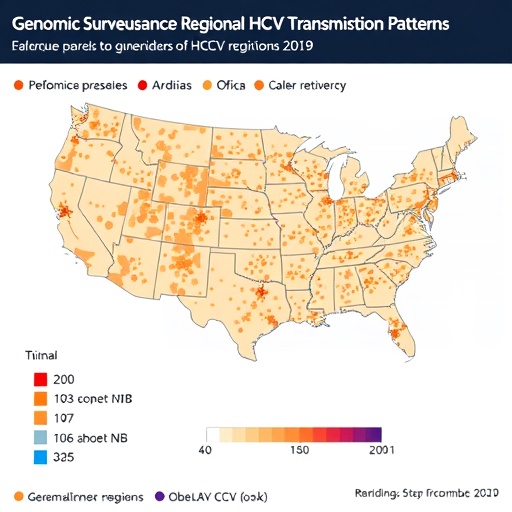
In a groundbreaking study published in Nature Communications in 2025, researchers led by Tully, Bean, and Sarette have unveiled critical insights into the dynamics of Hepatitis C Virus (HCV) transmission across rural regions in the United States. Employing advanced genomic surveillance techniques, the team has uncovered significant regional variation in transmission networks, shedding new light on how the virus spreads in geographically and socially diverse populations. This research not only enhances our understanding of HCV epidemiology but also carries profound implications for targeted public health interventions aimed at curtailing the spread of this chronic bloodborne pathogen.
The study hinges on the power of viral genome sequencing to track transmission patterns at a molecular level, representing a revolutionary step forward in infectious disease surveillance. Traditional epidemiological approaches, often reliant on case reports and risk-factor analyses, have struggled to map transmission chains accurately in rural areas where healthcare access and epidemiological data are limited. By contrast, genomic surveillance leverages the subtle genetic fingerprints embedded in viral genomes, enabling scientists to reconstruct networks of transmission with unprecedented detail.
A critical finding from Tully and colleagues’ work is the observation of considerable heterogeneity in transmission clusters across different rural regions. Rather than a uniform spreading pattern, HCV transmission exhibits distinct regional characteristics, driven by localized social, economic, and behavioral factors. This variation underscores the complexity of HCV epidemiology in rural America, challenging one-size-fits-all public health strategies and advocating for regionally customized responses.
The methodology employed involved collecting blood samples from diverse rural populations confirmed to have active HCV infection. High-throughput next-generation sequencing was applied to isolate and decode viral RNA genomes at scale. With this dataset, the researchers performed phylogenetic analyses to infer evolutionary relationships and transmission linkages between viral isolates. Such analyses can detect close genetic proximity indicative of recent transmission events between individuals, allowing a reconstruction of viral spread dynamics within communities.
An intriguing aspect of the results is the identification of “hotspots” where transmission clusters were particularly dense and active. The emergence of such hubs suggests focal points of viral propagation, possibly linked to shared venues or behaviors such as injection drug use. Moreover, the study highlights the role of social network structures in amplifying HCV spread, with transmission chains often extending through close-knit community contacts rather than random encounters.
From a viral genetics standpoint, the researchers discovered subtle but meaningful genomic variations among different regional HCV strains. These genetic signatures not only enable the discrimination of transmission clusters but may also correlate with viral fitness, treatment response, and potential resistance mutations. Understanding how viral genetics intersect with epidemiological patterns provides an essential foundation for developing precision medicine approaches tailored to local viral populations.
Public health implications are profound. Recognition of regional differences in transmission networks calls for more nuanced surveillance and intervention strategies. Resources can be better allocated to prioritize high-risk rural communities where transmission is most intense. Additionally, genomic data can inform contact tracing efforts, enabling earlier identification of outbreaks and reducing onward spread. The findings also support the integration of genomic epidemiology with traditional field investigations to create comprehensive control frameworks.
Perhaps one of the most striking contributions of this study is its demonstration of the feasibility and utility of large-scale genomic surveillance in resource-limited rural settings. The implementation of cutting-edge sequencing technology outside of urban research centers represents a significant logistical achievement, suggesting a scalable blueprint for similar initiatives targeting other pathogens. This democratization of genomic epidemiology could revolutionize infectious disease monitoring in underserved regions worldwide.
The researchers also emphasize the critical role of multidisciplinary collaboration in achieving these outcomes. The fusion of molecular biology, computational genomics, epidemiology, and public health expertise was essential to translate raw sequencing data into actionable insights. This integrative approach sets a new standard for future investigations into complex transmission dynamics of chronic viral infections.
Furthermore, the study highlights the urgent need for robust data-sharing frameworks that protect patient privacy while enabling real-time genomic data exchange among public health agencies. Ethical considerations around data use and community engagement are particularly salient in rural contexts where mistrust of external authorities may hinder intervention efforts. Addressing these challenges is vital to fully harness the benefits of genomic surveillance.
The temporal dimension of the analysis is also noteworthy. By sequencing samples collected over multiple years, the team could track temporal shifts in transmission networks and detect emerging outbreaks early. Such longitudinal surveillance is a powerful tool for assessing the impact of public health interventions and adjusting strategies dynamically as epidemic landscapes evolve.
In sum, the research by Tully and colleagues marks a pivotal advance in our understanding of HCV transmission in rural America. It demonstrates that viral genomics, when combined with innovative analytic frameworks and community-focused public health strategies, can illuminate the hidden contours of viral spread. This knowledge is crucial for achieving the ultimate goal of viral elimination, particularly in populations historically underserved by traditional health infrastructure.
As HCV remains a leading cause of chronic liver disease and hepatocellular carcinoma globally, and given the opioid epidemic’s role in fueling its spread, the insights from this study could not be more timely. Future research building on this work may extend genomic surveillance to other hepatitis viruses and bloodborne pathogens, propelling a new era of precision public health.
This study exemplifies the transformative potential of interdisciplinary science and technology in addressing persistent infectious disease challenges. The fusion of genomics and epidemiology promises to catalyze not just incremental advances but paradigm shifts in how we detect, understand, and ultimately control viral epidemics.
Cite Scienmag News
Kristina Jarvis. (December 2, 2025). Genomic Surveillance Reveals Regional HCV Transmission Patterns. Scienmag. https://scienmag.com/genomic-surveillance-reveals-regional-hcv-transmission-patterns/
Kristina Jarvis. "Genomic Surveillance Reveals Regional HCV Transmission Patterns." Scienmag, 2 December 2025, https://scienmag.com/genomic-surveillance-reveals-regional-hcv-transmission-patterns/. Accessed 3 September 2026.
Kristina Jarvis. "Genomic Surveillance Reveals Regional HCV Transmission Patterns." Scienmag. December 2, 2025. https://scienmag.com/genomic-surveillance-reveals-regional-hcv-transmission-patterns/


