


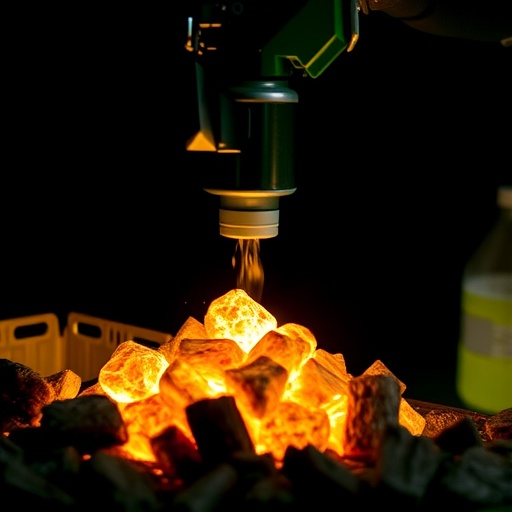
In a groundbreaking advance poised to reshape the landscape of green chemistry and sustainable catalysis, researchers have unveiled a novel method of recycling waste catalysts by harnessing the self-doping capabilities of biological secretions. This innovative approach, detailed in a recent publication in Nature Communications, offers a promising avenue to significantly reduce the environmental footprint of chemical manufacturing processes, heralding a new era where nature-inspired techniques and industrial chemistry converge.
Catalysts are indispensable in countless chemical reactions, accelerating processes and improving yields without being consumed. However, their degradation over time and eventual disposal pose significant environmental and economic challenges. Traditional catalyst regeneration techniques often involve energy-intensive procedures or the use of harsh chemicals, which can negate some of the green benefits of catalysis itself. The study in question explores an alternative pathway that leverages the self-doping capacity inherent in certain biological secretions to rejuvenate spent catalysts, turning waste into valuable reusable resources.
At the heart of this pioneering research lies an intricate understanding of the molecular interplay between biological secretions—complex fluids produced by living organisms—and the surface chemistry of catalysts. These secretions contain a diverse array of organic and inorganic components that interact synergistically with catalyst materials, enabling the self-doping process. Doping, in this context, refers to the intentional introduction of foreign atoms into the catalyst’s lattice structure to enhance its electronic properties, thereby restoring or even improving its catalytic performance.
The team employed a multidisciplinary approach combining materials science, biochemistry, and surface engineering to uncover the mechanisms underlying this phenomenon. Using advanced spectroscopic and microscopic techniques, they observed how secretions, rich in metal ions and organic molecules, facilitated the controlled insertion of dopant species into the catalyst frameworks. Remarkably, this process occurred spontaneously under mild conditions—at room temperature and ambient pressure—eschewing the need for high-energy inputs that typify conventional doping methods.
One of the most striking findings was the role of specific biomolecules in directing the doping process. Proteins and polysaccharides within the secretions functioned as natural chelators and reducing agents, precisely modulating the chemical environment around the catalyst. This not only enabled the selective incorporation of dopants but also protected the catalyst’s active sites from deactivation, prolonging its lifespan. The self-doping effect resulted in enhanced catalytic activity and stability, features that are critical for industrial application.
The implications of this self-doping strategy extend beyond environmental stewardship. Economically, the ability to reuse waste catalysts without extensive processing could drastically cut costs associated with catalyst procurement and disposal. Moreover, the approach opens new frontiers in catalyst design, where biological secretions themselves could be engineered or customized to optimize doping profiles for specific reactions. This biocompatible and adaptive methodology presents a platform that seamlessly integrates with sustainable manufacturing practices.
To validate the practical potential, the research team applied their self-doping technique to various widely used catalytic systems, including metal oxides and transition metal-based catalysts involved in key industrial reactions such as hydrogenation, oxidation, and carbon-carbon bond formation. In all cases, the regenerated catalysts exhibited performance metrics on par with—or superior to—fresh catalysts synthesized through traditional routes. Additionally, the process demonstrated remarkable repeatability, sustaining catalyst efficacy over multiple regeneration cycles without significant degradation.
Beyond immediate utility, this discovery shines a light on the untapped potential of biological secretions as a reservoir of functional materials with catalytic relevance. The natural world, through billions of years of evolution, has fine-tuned biochemical pathways that can inspire novel solutions to contemporary material science problems. By bridging biological and synthetic chemistry, this work emphasizes the power of biomimicry in achieving technological breakthroughs that align with circular economy principles.
The study also raises provocative questions about the diversity and specificity of biological secretions across different organisms and environments. Future investigations could explore tailoring secretion profiles through genetic engineering or environmental modulation to produce bespoke doping agents. Moreover, understanding the kinetics and thermodynamics governing self-doping interactions could facilitate predictive models, enabling rational design of catalytic systems optimized for both performance and sustainability.
Fundamentally, this research represents a paradigm shift in how scientists conceptualize catalyst lifecycle management. Instead of viewing spent catalysts as mere waste, they are reimagined as dynamic materials capable of self-renewal through interaction with biological milieus. Such a vision aligns seamlessly with the ethos of green chemistry, which prioritizes waste minimization, resource efficiency, and safer chemical synthesis routes.
Critically, the environmentally benign nature of this self-doping method addresses a vital concern in the chemical industry: reducing the reliance on hazardous reagents and energy-intensive procedures. By demonstrating that biological secretions can act as multifunctional doping agents and stabilizers, the approach redefines the roles biomolecules play beyond their traditional biological functions, positioning them as key players in sustainable material science.
Furthermore, the research opens exploratory pathways in other fields, such as environmental remediation, energy conversion, and sensor development, where catalyst functionality and durability are paramount. The principles elucidated here could inform the design of self-healing materials and smart interfaces responsive to biological stimuli, expanding the frontiers of adaptive materials technology.
Importantly, the interdisciplinary collaboration underscored in this study exemplifies the synergy required to address complex challenges at the intersection of biology, chemistry, and engineering. Bringing together experts in biochemistry, nanotechnology, and catalysis was pivotal in unraveling the nuanced interactions driving self-doping and validating their practical applicability, setting a precedent for future endeavors in sustainable materials innovation.
In summary, the self-doping capabilities inherent in biological secretions represent a transformative strategy for waste catalyst reuse, merging the sophistication of natural biochemical systems with the demands of industrial catalysis. As industries strive towards greener, more sustainable processes, such innovations will be instrumental in balancing performance with environmental responsibility. This research not only furnishes a blueprint for catalyst regeneration but also underscores the profound possibilities unlocked when material science dialogues deeply with the living world.
Researchers and industry stakeholders alike are closely watching how this concept evolves from laboratory demonstration to commercial scale-up. Challenges remain in harvesting and standardizing biological secretions, scaling regeneration processes, and integrating the approach into existing manufacturing infrastructures. Nevertheless, the compelling advantages in ecological impact and economic viability position self-doping as a beacon in the future landscape of catalytic science and sustainability.
As the field moves forward, attention will turn to refining the molecular understanding of doping interactions and expanding the repertoire of biological secretions harnessed for catalyst rejuvenation. Collaborative efforts involving synthetic biology, computational modeling, and process engineering are anticipated to accelerate innovation, ultimately enabling more efficient, eco-friendly, and cost-effective production cycles that resonate with the global imperative of sustainable development.
This pioneering work not only advances the science of catalysis but also inspires a larger philosophical dialogue about the integration of living systems and technologies. By learning from and leveraging the intricate chemistries of nature, humanity can foster novel paradigms where waste transforms into wealth, and sustainability transcends aspiration becoming an operational reality.
Cite Scienmag News
Bethany Barker. (December 2, 2025). Self-Doping Boosts Reuse of Waste Catalysts. Scienmag. https://scienmag.com/self-doping-boosts-reuse-of-waste-catalysts/
Bethany Barker. "Self-Doping Boosts Reuse of Waste Catalysts." Scienmag, 2 December 2025, https://scienmag.com/self-doping-boosts-reuse-of-waste-catalysts/. Accessed 4 September 2026.
Bethany Barker. "Self-Doping Boosts Reuse of Waste Catalysts." Scienmag. December 2, 2025. https://scienmag.com/self-doping-boosts-reuse-of-waste-catalysts/


