


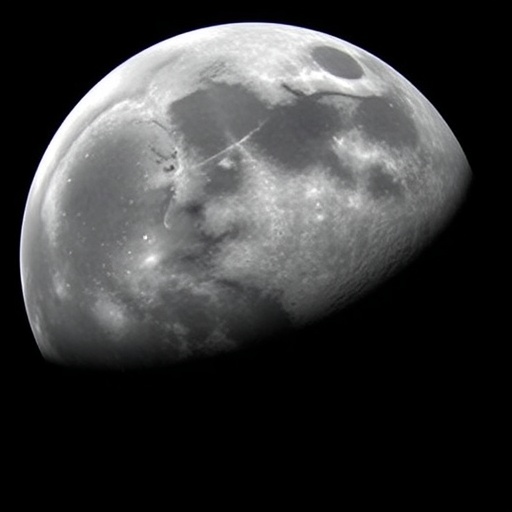
In a groundbreaking study, researchers led by Su, B., along with Chen, Y., and Chen, H., delve into the complex crust–mantle architecture of the Moon’s South Pole–Aitken (SPA) basin, which is the largest and one of the oldest impact craters on the Moon’s surface. The SPA basin spans over 2,500 kilometers in diameter and reaches depths of approximately 13 kilometers, offering a unique geological feature through which scientists can explore the Moon’s history and evolution. The team utilized samples acquired by the Chang’e-6 mission, a pivotal project in lunar exploration that highlights China’s burgeoning capabilities in space research.
Through meticulous analysis, the study reveals intricate details about the composition and structure of the lunar crust and mantle beneath the SPA basin. The mission’s samples provided invaluable insights into the elemental and mineralogical constituents of the Moon’s surface, thereby allowing researchers to formulate sophisticated models of the lunar geological framework. These insights are not merely academic; they have implications for our understanding of the Moon’s formation, evolution, and the processes that shaped its geological features over billions of years.
An important aspect of the study involves understanding the differentiation processes that have shaped the Moon’s crust and mantle. The SPA basin offers a window into these processes, which involve the separation of materials based on their densities to form distinct layers within the lunar interior. By examining isotopic ratios and mineral compositions from the Chang’e-6 samples, the research team has been able to infer the history of these differentiation events, shedding light on the thermal and chemical evolution of the Moon since its formation.
Among the findings are surprising revelations regarding the depth and composition of the lunar crust. The research suggests that the crust beneath the SPA basin may be thinner than previously estimated. This challenges long-held notions about the Moon’s geological history and provides a fresh perspective on the events leading to the basin’s formation. Furthermore, the analysis indicates that the crust may be more heterogeneous than once believed, containing a complex mix of materials that reflect a dynamic history of impact events and volcanic activity.
Impact craters are pivotal in understanding planetary geologies. The SPA basin itself serves as a profound reminder of the Moon’s violent past, reflecting a period of intense bombardment in the early solar system. The study not only emphasizes the significance of the SPA basin as a geological feature but also contextualizes it within the broader narrative of lunar history. By studying such giant craters, scientists can reconstruct the chronological timeline of impacts and their effects on the Moon’s surface and interior.
The implications of this research extend beyond the Moon. Understanding the crust and mantle of our lunar neighbor aids in refining models of planetary formation and evolution across the solar system. By drawing parallels between the Moon’s geological history and that of other celestial bodies, researchers can gain insights into the processes that shaped not only the Earth but also planets and moons across our cosmic neighborhood.
Moreover, this study underscores the importance of international collaboration and technological innovation in space exploration. The Chang’e-6 mission represents a significant achievement in China’s space program, showcasing the capabilities of contemporary lunar missions to gather data, conduct analyses, and enhance our understanding of planetary sciences. The meticulous work conducted by the research team exemplifies the role of advanced analytical techniques in deciphering complex geological puzzles.
Furthermore, the research reinvigorates interest in future lunar missions. As humanity stands on the cusp of returning to the Moon through upcoming missions, the knowledge gleaned from the Chang’e-6 samples will undoubtedly influence mission planning and scientific objectives. Future explorers may prioritize regions near the SPA basin, drawn by the promise of unraveling further mysteries surrounding the Moon’s geological past and its implications for understanding planetary evolution.
In the context of Earth-Moon relationships, the study also prompts critical questions about the resources that may lie beneath the surface of the Moon. As discussions around lunar mining initiatives gain momentum, understanding the Moon’s geology becomes paramount. The materials identified in the SPA basin could potentially serve as resources for future lunar missions and contribute to sustainable human presence on the Moon.
As the research delineates the complex architecture of the Moon’s South Pole–Aitken basin, it also brings attention to the broader implications for scientific inquiry. The methodology employed in this study showcases the intersection of geology, chemistry, and space science, epitomizing how multidisciplinary approaches can lead to richer insights. The synthesis of data from advanced instrumentation, coupled with rigorous analytical frameworks, enhances the credibility of the findings and elevates the quality of lunar research.
The global scientific community eagerly anticipates the proliferation of knowledge stemming from this research. With the rapid pace of lunar exploration, the insights derived from the Chang’e-6 mission may serve as a catalyst for further studies, fostering dialogue among scientists around the world. The study serves as a reference point for future inquiries and exploration strategies, demonstrating that even the Moon, a familiar object in our night sky, still harbors profound secrets that are waiting to be unveiled.
In conclusion, the work presented by Su, B., and colleagues represents a significant advancement in our understanding of the Moon’s geology, particularly regarding the South Pole–Aitken basin. This research not only enriches the historical narrative of lunar exploration but also highlights the vast potential for future discoveries. As we venture further into the cosmos, the lessons learned from our celestial neighbor will continue to inform our understanding of planetary processes, the history of our solar system, and the future of humanity in space.
Su, B., Chen, Y., Chen, H. et al. Crust–mantle architecture of the Moon’s South Pole–Aitken basin from Chang’e-6 samples.
Commun Earth Environ (2025). https://doi.org/10.1038/s43247-025-03056-9
Cite Scienmag News
Violet Maxwell. (December 1, 2025). Chang’e-6 Reveals Moon’s South Pole–Aitken Structure. Scienmag. https://scienmag.com/change-6-reveals-moons-south-pole-aitken-structure/
Violet Maxwell. "Chang’e-6 Reveals Moon’s South Pole–Aitken Structure." Scienmag, 1 December 2025, https://scienmag.com/change-6-reveals-moons-south-pole-aitken-structure/. Accessed 3 September 2026.
Violet Maxwell. "Chang’e-6 Reveals Moon’s South Pole–Aitken Structure." Scienmag. December 1, 2025. https://scienmag.com/change-6-reveals-moons-south-pole-aitken-structure/


