


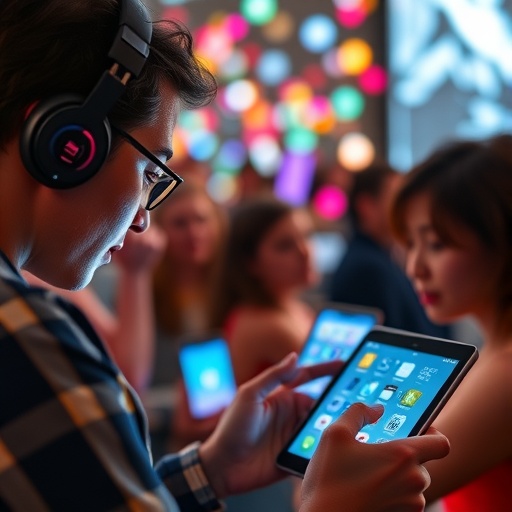
In an age dominated by digital connectivity, the role of social media in shaping various facets of human life is undeniable. Yet, new insights from a recent study published in BMC Psychology shed light on an increasingly concerning phenomenon: social media overload and its significant effects on learning engagement. This groundbreaking research, conducted by Duan, Li, Kanchanapoom, and colleagues, delves into how excessive social media use can detrimentally impact students’ ability to focus and engage with educational content, providing a nuanced understanding of this modern challenge.
As digital platforms burgeon, social media has transformed from a mere communication tool into a ubiquitous environment where information, interactions, and entertainment compete for users’ attention. However, this overwhelming influx of content frequently leads to cognitive saturation, a condition referred to as social media overload. The study explores this overload not just as a quantitative excess but through a sophisticated moderated mediation model that illuminates the underlying mechanisms by which social media impacts learning engagement.
At the heart of the investigation is the critical relationship between social media overload and students’ immersive engagement in educational activities. The researchers propose that as learners encounter an unrelenting flow of social stimuli, their cognitive resources become increasingly taxed, reducing their capacity to process academic materials effectively. This diminished engagement not only affects immediate academic performance but may also undermine long-term educational aspirations.
The employed moderated mediation model represents a notable advancement in understanding the interplay of variables influencing learning engagement. By integrating psychological constructs such as cognitive load, emotional exhaustion, and self-regulated learning strategies, the model offers a comprehensive framework that captures both direct and indirect pathways through which social media overload exerts its influence. Furthermore, the study identifies critical moderating factors, such as individual resilience and social support, that can buffer or exacerbate these effects.
One of the pivotal findings underscores the mediating role of cognitive fatigue induced by social media overload. Cognitive fatigue emerges as a crucial psychological state wherein prolonged exposure to excessive social interactions leads to a depletion of mental energy necessary for learning. The study meticulously quantifies this mediation effect, demonstrating that cognitive fatigue significantly contributes to the reduction in learning engagement among social media users experiencing overload.
Adding complexity to the model, emotional exhaustion is also highlighted as a mediator that connects social media overload with diminished learning engagement. This affective component reflects the emotional drain resulting from constant connectivity and the pressure to keep up with digital social demands. The research illustrates that emotional exhaustion can independently impair motivation and attention, compounding the decline in educational engagement.
Beyond these mediators, the role of self-regulated learning strategies emerges as a decisive moderator within the model. The participants who utilized effective self-regulation—such as goal-setting, time management, and strategic planning—were found to mitigate the adverse impacts of social media overload. This insight opens promising avenues for educational interventions aimed at enhancing learners’ metacognitive skills to safeguard against digital distractions.
Another noteworthy moderator examined in the study is social support, encompassing both offline and online relational networks that provide emotional and practical assistance. Strong social support systems were shown to alleviate the negative effects of social media overload, highlighting the importance of fostering nurturing environments in educational settings to sustain engagement.
Methodologically, the study employed a robust data collection process involving a diverse sample of students utilizing validated psychometric scales to measure social media overload, cognitive fatigue, emotional exhaustion, and learning engagement. The application of sophisticated statistical techniques, including structural equation modeling, ensured precise estimation of the moderated mediation effects, strengthening the reliability and generalizability of the results.
This research carries profound implications for educators, policymakers, and mental health professionals alike. In an educational landscape increasingly interwoven with digital modalities, recognizing and addressing social media overload is paramount. Interventions designed to foster self-regulated learning and bolster social support could serve as effective strategies to combat the adverse consequences identified.
Moreover, this study contributes to the broader discourse on digital well-being by framing social media overload within an academic context, illustrating tangible impacts rather than abstract concerns. It challenges stakeholders to reconsider how digital platforms are integrated within educational frameworks and urges the creation of balanced digital ecosystems that prioritize cognitive and emotional health.
Importantly, the findings resonate beyond academia, touching on the societal implications of pervasive digital engagement. As younger generations invest growing portions of their time online, understanding the psychological mechanisms that mediate and moderate digital stressors is crucial for fostering healthier interactions with technology.
The study also underscores the need for future research to explore longitudinal effects and potential demographical differences in responses to social media overload. By extending this work, scholars can develop more targeted interventions and customized support systems that address the unique challenges faced by different learner populations.
In sum, the work by Duan and colleagues serves as a clarion call to reassess our collective relationship with social media, especially in contexts where cognitive and emotional capacities are vital. It articulates a detailed and empirically grounded narrative of how social media overload hampers learning engagement, while offering a roadmap for mitigating these effects through cognitive and social resources enhancement.
As digital platforms continue to evolve and integrate into everyday learning experiences, such research becomes indispensable. It equips educators and learners with the conceptual tools required to navigate the complex terrains of digital engagement without succumbing to its potentially overwhelming side effects.
Ultimately, this study reflects the critical intersection of technology, psychology, and education—an arena where understanding human cognitive limits is as vital as embracing technological innovations. The moderated mediation model presented not only broadens theoretical horizons but stands as a practical guide for crafting educational experiences that promote sustainable and healthy digital participation.
Cite Scienmag News
Glenn Wilkins. (December 1, 2025). Social Media Overload Disrupts Learning Engagement, Study Finds. Scienmag. https://scienmag.com/social-media-overload-disrupts-learning-engagement-study-finds/
Glenn Wilkins. "Social Media Overload Disrupts Learning Engagement, Study Finds." Scienmag, 1 December 2025, https://scienmag.com/social-media-overload-disrupts-learning-engagement-study-finds/. Accessed 4 September 2026.
Glenn Wilkins. "Social Media Overload Disrupts Learning Engagement, Study Finds." Scienmag. December 1, 2025. https://scienmag.com/social-media-overload-disrupts-learning-engagement-study-finds/


