


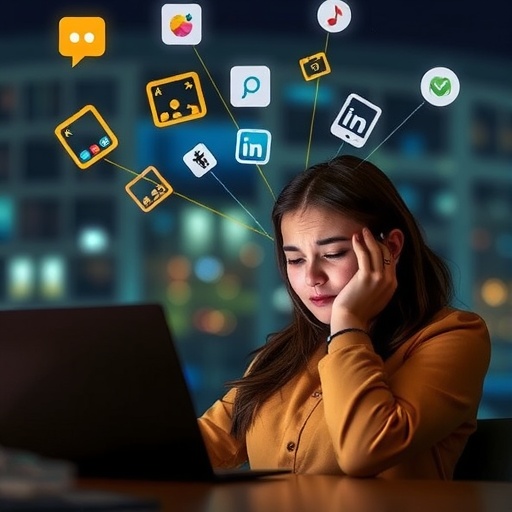
In an era dominated by rapid digital connectivity, the psychological toll of incessant social media use is gaining critical attention in scientific circles. A groundbreaking investigation, recently published in BMC Psychology, delves deeply into how digital stress influences problematic social media behavior among college students. This study shines a light on the intricate emotional mechanisms that govern online habits, offering profound insights into how cognitive strategies can potentially moderate these effects.
The researchers, Zhan, Luo, and Hu, embarked on an empirical journey to unravel the dual emotional pathways that mediate the relationship between digital stress and problematic engagement with social media platforms. Their work is a vital contribution to our understanding of the psychological underpinnings of digital life, especially as young adults consistently grapple with the pressures and challenges posed by ubiquitous connectivity.
Digital stress, as conceptualized in this study, refers to the strain and anxiety generated by exposure to digital environments, including social media platforms. The incessant notifications, the pressure to maintain an appealing online persona, and the constant influx of information can overwhelm users. This stress, when chronic, can precipitate maladaptive patterns of social media use that interfere with daily functioning, academic performance, and overall well-being.
The study strategically explores two emotional pathways: one rooted in negative affect and the other in diminished positive affect. Negative affect encompasses feelings such as anxiety, sadness, and anger, which are commonly exacerbated by adverse online interactions or social comparison. Conversely, a decrease in positive affect manifests as reduced feelings of joy, satisfaction, and optimism related to social media use. Both pathways independently and collectively contribute to the risk of problematic social media behavior.
To elucidate these dynamics, the authors employed sophisticated psychometric assessments among a cohort of college students—a demographic notably vulnerable to the compulsions and pressures of social networking. This population is particularly important since their developmental stage involves identity formation, social connectivity, and academic demands that digital platforms uniquely influence.
Another pivotal facet of this research lies in the role of cognitive reappraisal, a conscious emotional regulation strategy wherein individuals reinterpret potentially distressing situations to alter their emotional impact. The study demonstrates that cognitive reappraisal can significantly moderate how digital stress affects emotional responses, thereby ameliorating the progression toward problematic social media usage.
This moderating effect is critical because it highlights a potential pathway for intervention. By fostering cognitive reappraisal skills, mental health professionals and educators may empower students to resist detrimental emotional spirals triggered by digital stress. This could pave the way for resilience-building programs that help young adults navigate the complex psychosocial landscape of online interaction.
Moreover, the dual emotional pathway model advanced in this research offers a more nuanced framework than traditional approaches that might consider emotional distress as a monolithic construct. Understanding the independent contributions of negative and positive affect enriches the theoretical landscape and opens new doors for targeted psychological interventions aimed at specific emotional domains.
The methodology of the study involved comprehensive questionnaires measuring levels of digital stress, emotional affect, cognitive reappraisal tendencies, and indicators of problematic social media use. Statistical modeling then elucidated the relationships among these constructs, revealing that emotional responses collectively mediate the link between stress and behavior in nuanced ways.
Importantly, the findings suggest that negative affect exerts a stronger influence on problematic social media use than does diminished positive affect. This asymmetry points to a particular vulnerability to negative emotional states, emphasizing the need to prioritize interventions that alleviate anxiety, depression, and irritability in digital environments.
This research also resonates powerfully in a broader societal context, where social media platforms have become central arenas for socialization, self-expression, and even academic collaboration. Although these platforms offer substantial benefits, the shadow of digital stress and its emotional sequelae cannot be ignored, especially as problematic use patterns escalate globally.
In addition to its theoretical implications, the study poses urgent practical considerations. University counseling centers and student support services might integrate training modules focused on cognitive reappraisal and emotional regulation. Such measures could mitigate the risk factors associated with problematic social media use, ultimately enhancing academic performance and psychological health.
Another noteworthy aspect of the research is its longitudinal potential. While the present data provide cross-sectional insights, future studies could track these emotional pathways over time to better understand causal relationships and the durability of cognitive reappraisal as a protective factor against escalating digital stress.
The intersection between technology use and mental health is increasingly prominent in contemporary research, and this study distinguishes itself through its meticulous focus on underlying emotional processes. It propels the discourse beyond surface-level associations between screen time and distress, offering a sophisticated model that integrates emotional regulation and stress responses in digital contexts.
Furthermore, the study’s findings echo calls for social media platforms themselves to consider design changes that reduce digital stressors. Features that promote positive interactions, minimize harmful comparisons, and support emotional well-being could help reduce the incidence of problematic behaviors rooted in digital stress.
The implications of this research extend to policy makers and educational leaders who must grapple with the challenge of balancing technological integration with mental health safeguards. The evidence underscores the necessity for comprehensive digital literacy programs that encompass not only technical competencies but also emotional resilience and regulation strategies.
In summary, Zhan, Luo, and Hu’s pioneering work offers a compelling narrative about the emotional undercurrents of social media use among college students. By dissecting the dual emotional pathways of negative and positive affect and spotlighting cognitive reappraisal as a vital moderating force, the study advances our understanding of digital stress and its psychological ramifications.
This research not only enriches academic literature but also provides an actionable framework for interventions aimed at fostering healthier digital habits. As the digital landscape evolves, so too must our approaches to digesting and mitigating the complex emotional experiences intertwined with social media engagement.
The study stands as a clarion call for continued exploration into the nuanced emotional interplay that fuels problematic online behaviors and emphasizes the power of cognitive strategies in reclaiming emotional balance in a digitally saturated world.
Cite Scienmag News
Glenn Wilkins. (November 30, 2025). Digital Stress, Social Media, and Emotions in College Students. Scienmag. https://scienmag.com/digital-stress-social-media-and-emotions-in-college-students/
Glenn Wilkins. "Digital Stress, Social Media, and Emotions in College Students." Scienmag, 30 November 2025, https://scienmag.com/digital-stress-social-media-and-emotions-in-college-students/. Accessed 4 September 2026.
Glenn Wilkins. "Digital Stress, Social Media, and Emotions in College Students." Scienmag. November 30, 2025. https://scienmag.com/digital-stress-social-media-and-emotions-in-college-students/


