


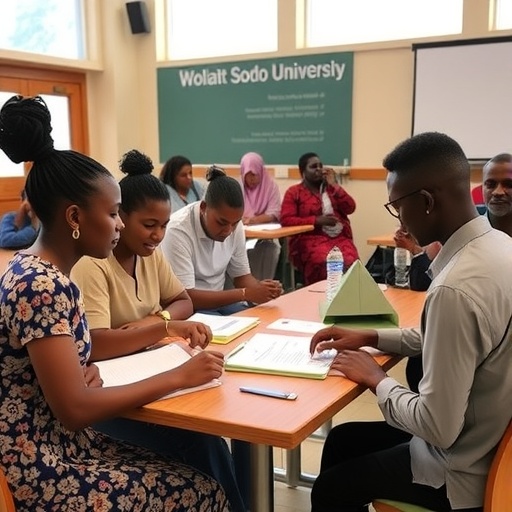
In a world rapidly evolving under the pressures of climate change and social inequalities, the importance of embedding sustainable development goals (SDGs) into institutional frameworks cannot be overstated. A recent study by D. Dalelo explores this pressing issue, focusing specifically on Wolaita Sodo University (WSU) in Ethiopia. This research presents a comprehensive assessment of how the university has incorporated SDGs into its core operations, offering a holistic institutional perspective that resonates with educational institutions globally.
Wolaita Sodo University, a prominent educational institution in Ethiopia, is making strides towards sustainability in a landscape fraught with challenges. By aligning its operations with the UN’s 2030 Agenda for Sustainable Development, the university aims to better prepare its students and staff to face the world’s most pressing issues. This study dives deep into the institution’s ongoing efforts, detailing both progress and areas needing improvement. By taking a systematic approach, WSU serves as a model for other universities aiming to contribute positively to sustainable development.
SDGs represent a global framework compelling institutions to act on interconnected challenges, such as poverty eradication, social justice, and environmental protection. Dalelo’s research reinforces the idea that universities are central to achieving these goals, given their capacity for research, community engagement, and higher education. Yet, the transition from theoretical frameworks to practical implementation is not straightforward. Dalelo’s work highlights that the integration of SDGs into WSU’s operations demands more than mere policy adoption; it necessitates a cultural and operational transformation within the institution.
The research identifies several key areas in which WSU is successfully integrating these goals. Collaborative projects with local communities showcase the university’s commitment to sustainable practices, including awareness campaigns on renewable energy and agricultural sustainability. Such programs not only reflect academic responsibility but also embody an actionable framework through which the university can foster real-world change. Engaging students in these initiatives sparks a passion for sustainability that extends beyond the classroom, empowering the next generation of leaders to make informed decisions.
Nevertheless, the study does not shy away from highlighting challenges in the integration process. Limited resources, inadequate training for faculty and staff, and insufficient institutional support have hindered full alignment with SDGs at WSU. These obstacles divert attention from sustainability efforts and risk diluting the impact of successful programs. Dalelo argues for a more robust support system that involves all stakeholders—administrators, faculty, students, and community members—to foster a cultural shift towards sustainable practices.
Dalelo emphasizes the importance of data-driven decision-making in the pursuit of sustainability. By using metrics to evaluate the effectiveness of their programs, WSU can measure success and identify areas for future investment. This analytical approach provides a foundation for transparency and accountability. By sharing outcomes with the broader community, the university not only promotes its efforts but also inspires other institutions to adopt similar strategies in their quest for sustainability.
In examining the curriculum, the research reveals a growing acknowledgment of sustainability principles among faculty and students. Courses that incorporate the SDGs empower learners to understand the complexities of global challenges and develop solutions grounded in scientific and ethical considerations. Interdisciplinary collaboration further enhances the educational experience, as students are encouraged to consider diverse perspectives on sustainable development.
An essential aspect of Dalelo’s study is the recognition of external partnerships in achieving sustainability. WSU engages with various stakeholders, including government agencies, non-profits, and private sectors, to bolster its efforts. These collaborations amplify resources and knowledge sharing, providing students with unique opportunities to work on real-life sustainability challenges. This network of partnerships serves to reinforce the university’s role as a leader in sustainable development within the region and beyond.
While WSU’s efforts are commendable, the research indicates that sustained momentum requires a long-term commitment. Institutional policies must evolve alongside the changing landscape of sustainability challenges. Dalelo calls for adaptive strategies that prioritize flexibility and innovation, ensuring that the university remains agile in its approach to integrating SDGs. Strategic planning should not be static; rather, it should embrace a dynamic process that incorporates feedback and assesses the growing needs of the community.
Given the urgency of global challenges, the responsibility educators have toward sustainability can hardly be overstated. Dalelo’s work positions WSU not just as an educational institution but as a vital community actor capable of addressing pressing social and environmental issues. As the university continues its journey towards comprehensive integration of SDGs, it charts a path for other institutions eager to harness the power of education as a tool for sustainable change.
In conclusion, Dalelo’s research on the integration of sustainable development goals into the operations of Wolaita Sodo University provides significant insight into the complexities surrounding this transformative process. While WSU is on the right track, the ongoing challenge lies in maintaining focus and momentum amid a constantly evolving landscape. The findings serve as both a celebration of achievements and a rallying call for further action within and beyond the university.
As we look to the future, the commitment demonstrated by institutions like WSU provides hope. Their work lays the groundwork for a new generation of leaders equipped to tackle the world’s most urgent sustainability challenges. Universities, as centers of knowledge and innovation, are poised to lead the charge towards a more sustainable and equitable world, and it is essential that they continue to investigate and refine their approaches to integrating these critical goals into their core operations.
Dalelo, D. Assessing the integration of sustainable development goals into core operations of Wolaita Sodo University from a holistic institutional perspective. Discov Sustain (2025). https://doi.org/10.1007/s43621-025-02350-y
Cite Scienmag News
Sloane Callahan. (November 29, 2025). Evaluating Sustainable Development Goals at Wolaita Sodo University. Scienmag. https://scienmag.com/evaluating-sustainable-development-goals-at-wolaita-sodo-university/
Sloane Callahan. "Evaluating Sustainable Development Goals at Wolaita Sodo University." Scienmag, 29 November 2025, https://scienmag.com/evaluating-sustainable-development-goals-at-wolaita-sodo-university/. Accessed 3 September 2026.
Sloane Callahan. "Evaluating Sustainable Development Goals at Wolaita Sodo University." Scienmag. November 29, 2025. https://scienmag.com/evaluating-sustainable-development-goals-at-wolaita-sodo-university/


