


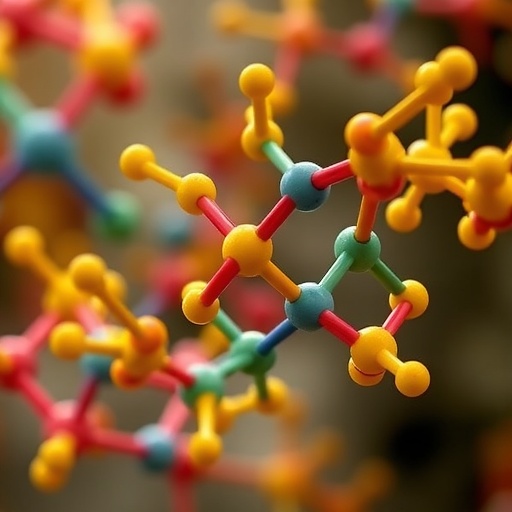
In a groundbreaking advancement poised to reshape materials science, researchers have unveiled a novel strategy to customize the toughness of polymer networks without altering their fundamental chemical composition or topology. Addressing a longstanding challenge in polymer chemistry, this new approach leverages the unique properties of tetrafunctional cyclobutanes (TCBs), mechanophores engineered to respond to mechanical stress in unprecedented ways. The discovery paves the way for creating single-network gels that can be finely tuned to exhibit a wide range of mechanical properties, especially toughness, broadening the scope of applications for these ubiquitous materials.
Polymer networks are integral to countless technologies, from biomedical devices and soft robotics to coatings and adhesives. However, enhancing a polymer network’s toughness—the ability to resist fracture under stress—typically requires complex interventions. These often involve blending specialized monomers, adding solvents, or integrating secondary networks and fillers. While effective, these modifications indiscriminately alter the material’s composition and can impose significant constraints, impacting biocompatibility, transparency, or recyclability. Achieving substantial toughening without these trade-offs has long eluded scientists.
The new research centered on mechanochemistry, a cutting-edge subfield that explores chemical reactions triggered by mechanical forces. Traditional mechanophores, which are molecules activated by stress, have mostly been bifunctional, meaning they respond to force in a linear, single-direction manner. Such mechanophores, although remarkable, cannot fully mimic the complex, multidirectional stresses experienced at the molecular level in polymer networks. Enter the tetrafunctional cyclobutanes—molecules designed to experience and respond to force applied simultaneously from multiple directions.
The core innovation lies in TCBs’ unique architecture. Unlike bifunctional mechanophores, these mechanophores possess four reactive sites arranged in a cyclobutane configuration. When force is applied, especially stress transmitted from multiple network strands converging on a single point, these tetrafunctional units undergo force-selective chemical reactions. This stress-selective reactivity alters the local network topology without needing to change its original chemical makeup. The consequence is a molecular-level intervention that can either dissipate energy or reinforce the network, enabling the customization of toughness.
One of the most remarkable outcomes of integrating TCBs into polymer networks is the ability to access toughness ranges not previously achievable in dilute end-linked gels. These gels, typically less robust due to low strand density, were transformed into remarkably tough materials simply by incorporating TCB mechanophores. This defies traditional expectations since toughness has often been correlated with monomer density or crosslink complexity. The TCBs’ force-coupled reactions provide a molecular mechanism distinct from conventional reinforcement.
Quantitatively capturing the effect of TCBs on bulk toughness, the researchers introduced a novel topological descriptor known as network strand continuity. This parameter describes how the mechanophore-induced reactions impact the continuity and connectivity of network strands locally. When the TCB mechanophores respond to multidirectional stress, they either promote the maintenance or controlled alteration of strand connectivity, effectively tuning how stress propagates through the network. This conceptual framework allows materials scientists to predict and engineer the toughness of gels with precision, bypassing empirical trial-and-error approaches.
This advance transcends mere laboratory curiosity by providing a robust design principle that can be seamlessly integrated into existing polymer network synthesis techniques. Importantly, the toughening effect arises independently of the network’s chemical composition or topology, highlighting TCBs as a modular, versatile additive. This versatility holds profound implications for fields demanding customizable mechanical properties without compromising other critical material qualities such as biocompatibility, optical clarity, or degradability.
Mechanically, the ability of TCB mechanophores to undergo stress-selective reactions under multiaxial force conditions mimics the natural complexity found in biological tissues, which often endure complex loading environments. By analogy, engineering this molecular personality into synthetic materials opens pathways toward biomimetic materials that combine toughness with adaptability, resilience, and potentially self-healing capabilities. It suggests a future where simple polymer gels rival the mechanical performance of complex, hierarchical natural materials.
Moreover, the discovery introduces TCB mechanophores as a new tool within the broader landscape of responsive materials. These materials change properties in response to external stimuli, and mechanochemistry adds a dimension where mechanical stress itself can dynamically alter material structure and function. The TCB approach enriches this paradigm by enabling localized, force-triggered chemical transformations that translate directly into macroscopic mechanical outputs, bridging molecular-scale events and bulk material behavior.
Practically, this finding could revolutionize sectors that rely on gels with tailored mechanical profiles. In medicine, for example, hydrogels tuned with TCBs may better mimic soft tissue mechanics, improving implant integration or drug delivery efficacy. Soft robotics could benefit from adaptable joints and actuators that stiffen or soften responsively, while coatings and adhesives might be engineered to resist mechanical damage more effectively without altering their base chemistry.
Importantly, the research methodology exemplifies a successful integration of synthetic chemistry, mechanical testing, and theoretical modeling. By systematically designing and incorporating TCB mechanophores, measuring network mechanics, and correlating observations through network strand continuity, the study offers an elegant and comprehensive demonstration of force-controlled material design. This multidisciplinary approach sets a new benchmark for mechanochemical research.
The authors acknowledge that while TCBs provide unprecedented control over toughness, challenges remain in fully exploiting their potential. Understanding the limits of force selectivity, reaction reversibility, and scalability of synthesis will be key to translating this technology from proof-of-concept to industrial applications. Nonetheless, the foundational principles uncovered here illuminate a clear path forward.
As the research progresses, the insights gained from TCB mechanochemistry could catalyze the development of a new class of smart polymer networks, where mechanical performance and chemical stability are no longer competing demands but harmonized features. This will empower engineers and scientists to create materials tailored precisely for their intended mechanical environments without compromising fundamental properties.
In summary, this pioneering work on tetrafunctional cyclobutanes represents a vanguard in polymer network engineering. By harnessing multidirectional force-selective mechanochemical reactivity, the study breaks new ground in tuning toughness independent of chemical composition and network topology. The implications for material design are profound, potentially transforming applications across biomedicine, soft robotics, coatings, and beyond. This paradigm shift underscores the transformative power of marrying molecular design with mechanical stimuli to unlock new horizons in materials science.
Cite Scienmag News
Bethany Barker. (November 14, 2025). Tetrafunctional Cyclobutanes Enhance Toughness Through Network Continuity. Scienmag. https://scienmag.com/tetrafunctional-cyclobutanes-enhance-toughness-through-network-continuity/
Bethany Barker. "Tetrafunctional Cyclobutanes Enhance Toughness Through Network Continuity." Scienmag, 14 November 2025, https://scienmag.com/tetrafunctional-cyclobutanes-enhance-toughness-through-network-continuity/. Accessed 6 September 2026.
Bethany Barker. "Tetrafunctional Cyclobutanes Enhance Toughness Through Network Continuity." Scienmag. November 14, 2025. https://scienmag.com/tetrafunctional-cyclobutanes-enhance-toughness-through-network-continuity/


