

Saturday, February 7, 2026
Science
No Result
View All Result
  • Login
  • HOME
  • SCIENCE NEWS
  • CONTACT US
  • HOME
  • SCIENCE NEWS
  • CONTACT US
No Result
View All Result
Scienmag
No Result
View All Result
Home Science News Chemistry

Ferroelectric material is now fatigue-free

June 6, 2024
in Chemistry
Reading Time: 2 mins read
0
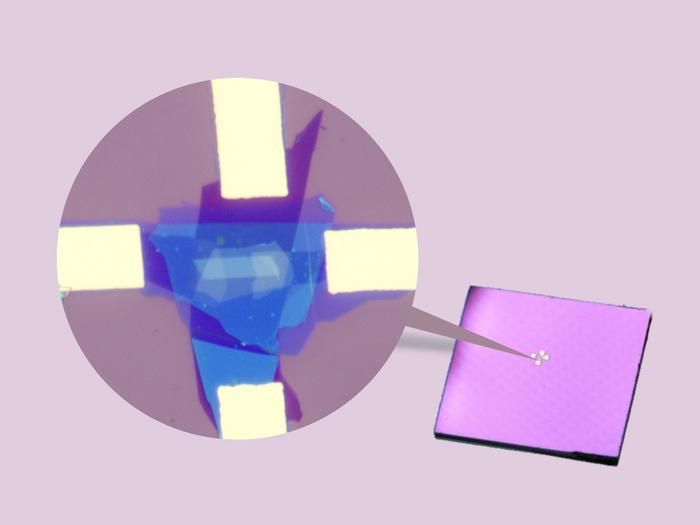
The sliding ferroelectricity endows ferroelectric materials with fatigue-free features
67
SHARES
606
VIEWS
Share on FacebookShare on Twitter
ADVERTISEMENT

Researchers at the Ningbo Institute of Materials Technology and Engineering (NIMTE) of the Chinese Academy of Sciences, in collaboration with research groups from the University of Electronic Science and Technology of China and Fudan University, have developed a fatigue-free ferroelectric material based on sliding ferroelectricity.

The sliding ferroelectricity endows ferroelectric materials with fatigue-free features

Credit: NIMTE

Researchers at the Ningbo Institute of Materials Technology and Engineering (NIMTE) of the Chinese Academy of Sciences, in collaboration with research groups from the University of Electronic Science and Technology of China and Fudan University, have developed a fatigue-free ferroelectric material based on sliding ferroelectricity.

The study was published in Science.

Ferroelectric materials have switchable spontaneous polarization that can be reversed by an external electric field, which have been widely applied to non-volatile memory, sensing, and energy conversion devices.

Due to the inherited ionic motion of ferroelectric switching, ferroelectric polarization fatigue inevitably occurs in conventional ferroelectric materials as the number of polarization reversal cycles increases. This can lead to performance degradation and device failure, thus limiting the practical applications of ferroelectric materials.

To solve this fatigue problem, the researchers developed a fatigue-free ferroelectric system based on sliding ferroelectricity. A bilayer 3R-MoS2 dual-gate device was fabricated using the chemical vapor transport method.

After 106 switching cycles with different pulse widths ranging from 1 ms to 100 ms, the ferroelectric polarization dipoles showed no loss, indicating that the device still retained its memory performance.

Compared with commercial ferroelectric devices, this device exhibits a superior total stress time of 105 s in an electric field, demonstrating its excellent endurance.

By means of a novel machine-learning potential model, theoretical calculations revealed that the fatigue-free property of sliding ferroelectricity can be attributed to its immobile charged defects.

This work provides an innovative solution to the problematic performance degradation of conventional ferroelectrics.

The study was supported by the National Natural Science Foundation of China and the Zhejiang Provincial Natural Science Foundation of China, among others.


Journal

Science

DOI

10.1126/science.ado1744

Method of Research

Experimental study

Subject of Research

Not applicable

Article Title

Developing fatigue-resistant ferroelectrics using interlayer sliding switching

Article Publication Date

6-Jun-2024

Share27Tweet17
Previous Post

Metabolic parameters similar in children born via frozen and fresh embryo transfer

Next Post

Seeking social proximity improves flight routes among pigeons

Related Posts

blank
Chemistry

Breakthrough in Environmental Cleanup: Scientists Develop Solar-Activated Biochar for Faster Remediation

February 6, 2026
blank
Chemistry

Cutting Costs: Making Hydrogen Fuel Cells More Affordable

February 6, 2026
blank
Chemistry

Scientists Develop Hand-Held “Levitating” Time Crystals

February 6, 2026
blank
Chemistry

Observing a Key Green-Energy Catalyst Dissolve Atom by Atom

February 6, 2026
blank
Chemistry

Saarbrücken Chemists Break New Ground: Iconic Aromatic Molecule Synthesized with Silicon After Decades of Global Pursuit

February 6, 2026
blank
Chemistry

How Cancer Cells Harness Water Pressure to Navigate the Body

February 6, 2026
Next Post
Seeking social proximity improves flight routes among pigeons

Seeking social proximity improves flight routes among pigeons

  • Mothers who receive childcare support from maternal grandparents show more parental warmth, finds NTU Singapore study

    Mothers who receive childcare support from maternal grandparents show more parental warmth, finds NTU Singapore study

    27610 shares
    Share 11040 Tweet 6900
  • University of Seville Breaks 120-Year-Old Mystery, Revises a Key Einstein Concept

    1017 shares
    Share 407 Tweet 254
  • Bee body mass, pathogens and local climate influence heat tolerance

    662 shares
    Share 265 Tweet 166
  • Researchers record first-ever images and data of a shark experiencing a boat strike

    529 shares
    Share 212 Tweet 132
  • Groundbreaking Clinical Trial Reveals Lubiprostone Enhances Kidney Function

    515 shares
    Share 206 Tweet 129
Science

Embark on a thrilling journey of discovery with Scienmag.com—your ultimate source for cutting-edge breakthroughs. Immerse yourself in a world where curiosity knows no limits and tomorrow’s possibilities become today’s reality!

RECENT NEWS

  • Improving Dementia Care with Enhanced Activity Kits
  • TPMT Expression Predictions Linked to Azathioprine Side Effects
  • Evaluating Pediatric Emergency Care Quality in Ethiopia
  • Post-Stress Corticosterone Impacts Hippocampal Excitability via HCN1

Categories

  • Agriculture
  • Anthropology
  • Archaeology
  • Athmospheric
  • Biology
  • Biotechnology
  • Blog
  • Bussines
  • Cancer
  • Chemistry
  • Climate
  • Earth Science
  • Editorial Policy
  • Marine
  • Mathematics
  • Medicine
  • Pediatry
  • Policy
  • Psychology & Psychiatry
  • Science Education
  • Social Science
  • Space
  • Technology and Engineering

Subscribe to Blog via Email

Enter your email address to subscribe to this blog and receive notifications of new posts by email.

Join 5,190 other subscribers

© 2025 Scienmag - Science Magazine

Welcome Back!

Login to your account below

Forgotten Password?

Retrieve your password

Please enter your username or email address to reset your password.

Log In
No Result
View All Result
  • HOME
  • SCIENCE NEWS
  • CONTACT US

© 2025 Scienmag - Science Magazine

Discover more from Science

Subscribe now to keep reading and get access to the full archive.

Continue reading
