


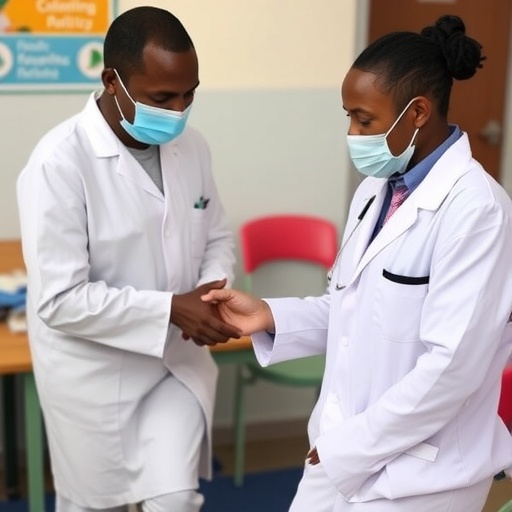
In an era where neglected tropical diseases continue to burden vulnerable populations, the integration of specialized healthcare services into mainstream facilities remains a critical challenge. Recent research emerging from Ethiopia highlights an innovative approach employed by non-governmental organizations (NGOs) to mainstream services for podoconiosis, a debilitating disease affecting millions. In a detailed study, these NGOs have demonstrated a blueprint for incorporating podoconiosis care directly into public health systems, offering promising avenues toward sustainable healthcare equity.
Podoconiosis, often overshadowed by more widely recognized tropical diseases, manifests as a non-infectious form of elephantiasis predominantly caused by prolonged exposure to irritant volcanic soils. This condition severely impacts affected individuals’ mobility and quality of life, while also invoking significant social stigma and economic hardship. Historically, podoconiosis management has existed on the periphery of public health priorities, reliant largely on fragmented, NGO-led interventions rather than integrated care pathways.
The Ethiopian experience, as documented by Engdawork, Tadele, Nahar, and colleagues, reveals a transformative strategy where two prominent NGOs have played pivotal roles in embedding podoconiosis services directly within the healthcare infrastructure. This paradigm shift moves away from vertical, disease-specific programs towards integrated health service delivery, thereby enhancing accessibility and sustainability. Their efforts reflect a sophisticated understanding of health systems strengthening, community engagement, and policy advocacy.
At the core of this initiative lies a comprehensive framework designed to train healthcare workers in early diagnosis, treatment protocols, and patient counseling specific to podoconiosis. By equipping frontline providers with enhanced competencies, these NGOs have bridged critical gaps in awareness and clinical capacity. This approach not only decentralizes care but also ensures that individuals affected by podoconiosis receive timely and standardized treatment across multiple healthcare touchpoints.
A technical highlight of the integration process involves the adaptation of existing clinical guidelines to encompass podoconiosis management. Standard operating procedures were developed to guide healthcare personnel in delivering wound care, hygiene instruction, and psychosocial support, with a strong emphasis on community-based rehabilitation. Such protocols are vital in managing the chronic nature of podoconiosis and reducing the frequency of acute dermatolymphangioadenitis episodes, which exacerbate disability.
Moreover, the NGOs instituted rigorous monitoring and evaluation (M&E) mechanisms to measure program effectiveness and patient outcomes. Data collection tools were embedded within routine health information systems to track service utilization, treatment adherence, and disease progression. This real-time data flow has empowered health managers to make evidence-driven decisions and facilitated the alignment of NGO activities with national health priorities.
Community mobilization emerged as another critical component in mainstreaming podoconiosis care. Awareness campaigns, informed by sociocultural insights, mobilized affected populations and reduced the stigma associated with the disease. By fostering local ownership and participation, NGOs enhanced trust and improved attendance at healthcare facilities. The iterative process of community engagement allowed for continuous feedback and refinement of service delivery models.
On the policy front, the NGOs actively engaged with public health authorities to advocate for the inclusion of podoconiosis in national health strategies and budget allocations. Their collaborative efforts underscored the necessity of health equity frameworks that recognize neglected diseases as integral to universal health coverage goals. Through policy dialogues and technical support, these organizations contributed to building political commitment at multiple governmental levels.
From a health systems perspective, the intervention demonstrated how task shifting and workforce optimization could address human resource constraints common in resource-limited settings. Nurses, health extension workers, and community volunteers were capacitated to perform roles traditionally reserved for specialists, thereby expanding service delivery without overburdening existing staff. This innovation speaks to the scalability and replicability of the model in similar endemic regions.
Financial sustainability was addressed through strategic partnerships and resource mobilization. By aligning with government financing mechanisms and integrating podoconiosis services into routine health budgets, the NGOs reduced dependence on external donor funding. This financial integration is fundamental to ensuring long-term program viability and resilience against fluctuating aid landscapes.
Technological integration also played an influential role. Mobile health (mHealth) platforms were employed to support training, supervision, and patient follow-up activities. These digital tools enhanced communication between healthcare providers and patients, promoted adherence to treatment regimens, and facilitated remote consultation, thereby overcoming geographic barriers inherent to rural Ethiopian settings.
Importantly, the research highlights the challenges encountered during the mainstreaming process, including initial resistance from health workers unfamiliar with podoconiosis, logistical constraints, and the complexity of coordinating multi-sectoral responses. Addressing these challenges required adaptive management strategies, emphasizing continuous learning and capacity-building initiatives.
The study’s implications extend beyond Ethiopia, offering a replicable model for other countries grappling with neglected tropical diseases and seeking to mainstream specialized care into primary healthcare systems. The combination of technical training, health system integration, community engagement, and policy advocacy embodied in this initiative provides a comprehensive roadmap to enhance health equity.
Future directions suggested by the authors include scaling up the mainstreaming approach nationally, exploring integration with other neglected tropical disease programs, and conducting longitudinal studies to assess long-term impacts on disease burden and socio-economic outcomes. The improving health indicators and reduced stigma emerging from initial implementations signal that such integrative frameworks can reshape the landscape of care for marginalized diseases.
In summary, this groundbreaking study elucidates how NGOs are not merely service providers but critical catalysts in redefining healthcare delivery models for neglected diseases. By embedding podoconiosis services into Ethiopia’s healthcare facilities, they have pioneered a transformative approach that challenges conventional vertical programming and advances the quest for equitable and sustainable health systems.
This conceptual and operational paradigm shift presents a compelling case for global health stakeholders to reimagine disease control strategies. As neglected diseases gain visibility, integrated service delivery—empowered by multifaceted NGO interventions—may well become the gold standard for inclusive health care, improving lives one community at a time.
Cite Scienmag News
Evelyn A. (November 6, 2025). NGOs Integrate Podoconiosis Care into Ethiopian Clinics. Scienmag. https://scienmag.com/ngos-integrate-podoconiosis-care-into-ethiopian-clinics/
Evelyn A. "NGOs Integrate Podoconiosis Care into Ethiopian Clinics." Scienmag, 6 November 2025, https://scienmag.com/ngos-integrate-podoconiosis-care-into-ethiopian-clinics/. Accessed 29 August 2026.
Evelyn A. "NGOs Integrate Podoconiosis Care into Ethiopian Clinics." Scienmag. November 6, 2025. https://scienmag.com/ngos-integrate-podoconiosis-care-into-ethiopian-clinics/


