

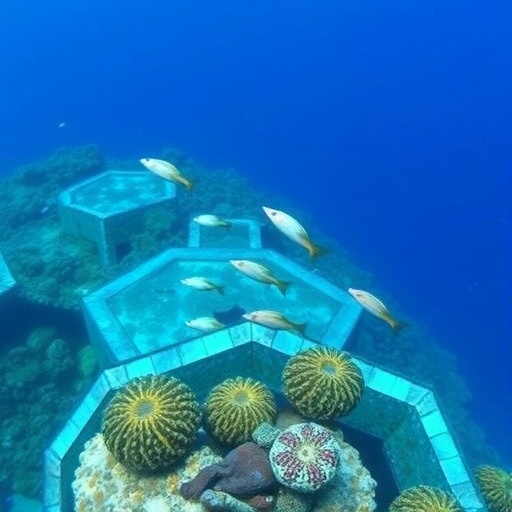
In a groundbreaking study published in the journal Nature, an international team of researchers unveils a profound transformation in Caribbean coral reef ecosystems, uncovering significant evidence of trophic simplification driven by human impacts. Utilizing an innovative nitrogen isotope method applied to fossilized fish otoliths—structures known as fish ear stones that preserve through millennia—scientists have reconstructed ancient reef food webs with unprecedented resolution. This research underscores stark differences between the ancient, pristine reefs from approximately 7,000 years ago and their modern counterparts, offering vital insights into how human activity has reshaped these critical marine communities.
The team, including experts from Boston College’s Department of Earth and Environmental Sciences’ Stable Isotope Biogeochemistry Lab, focused on chemical signatures preserved in fossil and contemporary otoliths and coral skeletons. By analyzing nitrogen isotopes bound within proteins, a powerful proxy for trophic level or position in the food chain, they quantitatively reconstructed the energy pathways and dietary diversity of the reef systems. This method, which had previously been challenged by the minute quantities of preserved proteins in fossils, was recently refined to allow such detailed examinations for the first time.
Their revelation is alarming: modern Caribbean coral reefs sustain food chains that are 60-70 percent shorter and exhibit 20-70 percent less functional diversity in their fish populations compared to those from the mid-Holocene epoch. This trophic simplification signals a homogenization of fish diets in degraded ecosystems, where various species now compete over a drastically limited array of resources. Such diminished dietary breadth severely undermines ecosystem resilience, increasing the vulnerability of reefs to collapse amid escalating environmental stressors.
Healthy coral reef ecosystems, once teeming with a complex network of species occupying varied trophic niches, have given way to systems where fish communities must rely on uniform food sources. Lead researcher Jessica Lueders-Dumont describes this loss of complexity akin to transitioning from a vibrant urban crucible of diverse culinary options to a single, monotonous menu. This analogy powerfully captures the cascading effects of biodiversity loss on the functional capacity of reef ecosystems.
Beyond the visible threats of climate change, overfishing, and pollution, this study highlights how underlying structural changes in reef food webs—often invisible to conventional ecological monitoring—constitute a pivotal factor in their degradation. The coral reefs of the Caribbean Sea, which have lost over half of their stony coral cover in recent decades, serve as a stark testament to these silent shifts in energy flow and trophic architecture.
Central to this research is the utilization of fossil deposits in Panama and the Dominican Republic. These sites preserve a rich array of shells, coral fragments, otoliths, and other biological remnants from both ancient and modern reefs. This dual record allowed for a direct and rigorous comparison of the same reef ecosystems across a vast temporal span, overcoming the limitations posed by the lack of systematic ecological baselines prior to widespread human influence.
The nitrogen isotope values extracted from the otolith proteins serve as biochemical fingerprints of each fish’s feeding level, revealing subtle yet significant alterations in reef food-chain structure. Assistant Professor Xingchen (Tony) Wang, co-author and director of the Stable Isotope Biogeochemistry Lab, emphasizes that these isotopic markers provide an analog to ancient DNA sequencing, unlocking hidden narratives about ancient ecosystems that were previously inaccessible.
Focusing on critical prey species such as gobies, silversides, and cardinalfish—termed the “potato chips of the reef” due to their fundamental role in reef trophodynamics—the analysis revealed shifts in their trophic positions as well. This indicates that human impacts extend beyond apex predators, permeating all levels of the food web and reshaping energy distribution from the bottom up.
Such comprehensive reconstructions of ancient trophic networks shed light on how historic reef food webs functioned with greater complexity and connectivity. Prior to human disturbances, these ecosystems exhibited diverse feeding strategies and trophic linkages that bolstered their stability and productivity. The modern contraction of these networks forewarns of diminished ecosystem services and impaired capacity for recovery amid escalating anthropogenic pressures.
The researchers caution that reliance on contemporary baselines for conservation has inherently limited our perspective, as modern reefs are already severely degraded. Establishing these deep-time ecological baselines offers a transformative lens through which scientists, conservationists, and policymakers can redefine what constitutes a “healthy” coral reef and guide restoration efforts grounded in historical ecological reality.
Looking forward, this research not only provides a template for assessing past responses of coral reefs to environmental change but also serves as a crucial reference point against which future trajectories of reef ecosystems can be gauged, especially in the context of rapid climate disruptions. These findings reinforce the urgent need to integrate paleoecological insights with modern management strategies to safeguard coral reefs—the biodiversity hotspots that sustain at least a quarter of all marine species.
Conclusively, by illuminating the hidden histories encoded within ancient fish ear stones, this study exemplifies innovative interdisciplinary approaches that bridge paleontology, geochemistry, and ecology. It opens up new avenues for understanding the full extent of human impact on marine ecosystems and underscores the indispensable value of scientific ingenuity in confronting global environmental challenges.
Subject of Research: N/A
Article Title: Fossil isotope evidence for trophic simplification on modern Caribbean reefs
News Publication Date: 11-Feb-2026
Web References: http://dx.doi.org/10.1038/s41586-025-10077-z
Image Credits: Michael Aw, Ocean Image Bank
Keywords: coral reef degradation, trophic simplification, nitrogen isotope analysis, fossil otoliths, Caribbean reefs, stable isotope biogeochemistry, marine food webs, biodiversity loss, ecosystem resilience, paleoecology, climate change, reef restoration


