

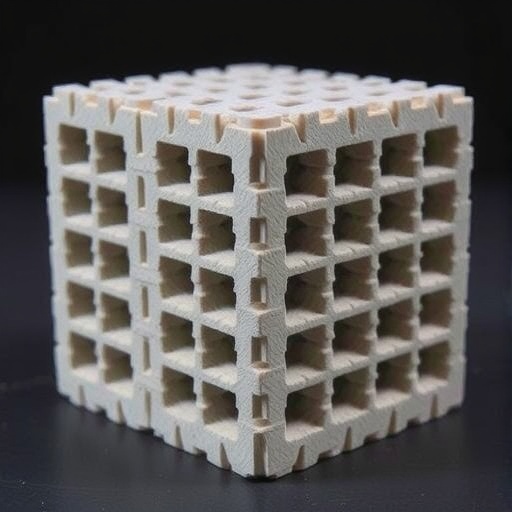
In the relentless pursuit of innovation within the construction industry, the integration of advanced materials and manufacturing techniques has ushered in transformative possibilities. One of the most compelling recent breakthroughs involves the development of 3D-printed concrete structures fortified with in-process embedded fiber-reinforced polymer (FRP) grid reinforcements. This novel approach, as detailed by Sun, HQ., Xie, SS., Zeng, JJ., and colleagues in their 2026 publication in Communications Engineering, represents a seismic shift in how we conceive, design, and realize concrete infrastructure. The fusion of additive manufacturing with cutting-edge composite reinforcements promises to overcome the enduring challenges of conventional concrete construction, creating new avenues for enhanced durability, resilience, and architectural freedom.
Concrete, the ubiquitous backbone of global infrastructure, traditionally suffers from inherent brittleness and limited tensile strength, mandating supplementary reinforcement to ensure structural integrity under load. Conventional steel rebar reinforcements, while effective, introduce complexities such as susceptibility to corrosion, labor-intensive placement, and geometric limitations. These factors often constrain design flexibility and increase maintenance costs, compelling engineers to seek alternative reinforcement strategies. The marriage of 3D printing technology with embedded FRP grids addresses these longstanding issues by integrating reinforcement directly during the printing process, streamlining construction and improving composite interaction at a microstructural level.
This innovative technique involves the layer-by-layer extrusion of concrete, during which a specifically designed fiber-reinforced polymer grid is simultaneously embedded within the printed layers. The FRP grids consist of high-strength, lightweight fibers such as carbon, glass, or basalt, impregnated with polymeric matrices that confer exceptional tensile performance and corrosion resistance. The embedded grids are customized in real time to adapt to complex geometries and variable load requirements, effectively tailoring reinforcement distribution within the printed structure. This level of integration promises a meaningful enhancement in crack resistance, flexural strength, and overall durability, surpassing what is achievable with traditional reinforcement methods.
Crucially, the in-process embedding technique bypasses the need for manual placement of reinforcing bars, which is often time-consuming and prone to human error. By synchronizing the FRP grid deposition with the concrete extrusion process, the technology enables precise control over the size, orientation, and spacing of reinforcement elements. This procedural coherence not only accelerates construction timelines significantly but also contributes to the accuracy and repeatability of structural properties. The adoption of robotics and advanced control algorithms orchestrates this dual-material deposition with micron-level precision, embodying the principles of Industry 4.0 in civil engineering applications.
From a material science perspective, the synergy between the cementitious matrix and the FRP reinforcement is pivotal. Traditional concerns around bond strength between concrete and polymer-based reinforcements are ingeniously mitigated by embedding the FRP grids during the fresh concrete phase, ensuring robust interfacial adhesion. This results in superior load transfer mechanisms and minimizes delamination risks under mechanical stress or environmental degradation. Furthermore, the fracture mechanics of the composite matrix benefit from the distributed reinforcement pattern, providing improved resistance against crack propagation and fatigue over the structure’s lifespan.
The implications for sustainability within the construction sector are considerable. The utilization of FRP grids, which are non-corrosive and lightweight compared to steel, reduces maintenance demands and extends service life, effectively lowering the lifecycle carbon footprint of concrete infrastructures. Additionally, the additive manufacturing approach minimizes construction waste by precision material emplacement and eliminates the need for formwork—a major source of environmental impact in conventional processes. The digital fabrication workflow further enables on-demand production, reducing transportation emissions and allowing for localized construction in remote or disaster-affected areas with limited access to conventional building materials.
On the architectural front, the marriage of 3D printing with embedded FRP reinforcement unlocks unprecedented freedom in form-making. Without the spatial constraints imposed by steel rebar placement, designers can explore complex, organic geometries and lightweight structural components that maintain structural integrity. This heralds a new era of aesthetically bold yet functionally superior concrete architecture that challenges the mundane orthogonality typical of traditional construction. The convergence of computational design tools and smart manufacturing facilitates bespoke structural optimization, marrying form, function, and sustainability in compelling ways never before possible.
Despite the groundbreaking progress demonstrated, challenges remain to be addressed before widespread industry adoption. The scalability of this technology must be proven across different environmental conditions and structural scales. Long-term durability studies are ongoing to validate performance under cyclic loading, exposure to aggressive chemicals, and thermal variations. Additionally, cost analyses are needed to assess whether upfront investments in robotic printing systems and novel materials deliver net economic benefits over lifecycles compared to established methods. Regulatory frameworks and building codes will also need to evolve to certify and govern these hybrid construction approaches effectively.
Looking ahead, the integration of smart sensing technologies within the 3D-printed FRP-reinforced concrete structures offers exciting potential to create self-monitoring infrastructure capable of real-time health diagnostics. Embedding fiber optic sensors and strain gauges within the reinforcement grids could enable predictive maintenance, preemptively alerting engineers to developing structural deficiencies and significantly increasing safety and cost-efficiency. Coupling this with advances in automation and AI-driven design optimization may revolutionize not only how concrete is constructed but how it is operated and managed throughout its lifespan.
The research by Sun and colleagues stands at the forefront of these developments, providing compelling experimental evidence and modeling insights that demonstrate the feasibility and performance advantages of this method. Their rigorous interdisciplinary approach draws upon materials science, robotics, civil engineering, and computational design, exemplifying the collaborative ethos needed to drive such innovation. By publishing their findings, they illuminate a path for researchers and industry practitioners to further refine and adopt this technology to meet the increasing demands for resilient, sustainable infrastructure in a rapidly changing world.
In summary, the advent of 3D-printed concrete embedded in-process with fiber-reinforced polymer grid reinforcement signals a transformative leap in construction technology. This breakthrough enhances structural performance, reduces environmental impact, accelerates building schedules, and broadens architectural horizons. The convergence of additive manufacturing with composite material science and smart automation embodies the next evolutionary stage of concrete infrastructure. While challenges in certification, scalability, and cost remain, the potential societal benefits are profound—offering safer, longer-lasting, and more adaptable built environments for future generations.
As the construction sector grapples with the need to rebuild aging infrastructure and meet escalating urban demands, innovations such as this will be vital. They provide not only technical solutions but opportunities to reinvent how we conceive urban spaces and engage with the built environment sustainably. The pioneering work on embedded FRP reinforcement within 3D-printed concrete stands as a beacon of what can be achieved when interdisciplinary research converges with visionary engineering, offering glimpses into a smarter, stronger construction future.
The ongoing collaboration between academia, industry, and policymakers will be crucial in translating this research from laboratory demonstrations to real-world applications. Investment in pilot projects, refinement of robotic systems, development of standards, and workforce training will accelerate the maturation and deployment of these cutting-edge techniques. Ultimately, the fusion of 3D printing and fiber-reinforced polymer reinforcement promises to redefine the architectural and engineering landscape, enabling structures capable of meeting humanity’s evolving functional and aesthetic needs while addressing pressing challenges like urbanization, climate resilience, and resource conservation.
Subject of Research: 3D-printed concrete structures with integrated fiber-reinforced polymer grid reinforcement.
Article Title: 3D-printed concrete with in-process embedded fiber-reinforced polymer grid reinforcement.
Article References:
Sun, HQ., Xie, SS., Zeng, JJ. et al. 3D-printed concrete with in-process embedded fiber-reinforced polymer grid reinforcement. Commun Eng (2026). https://doi.org/10.1038/s44172-026-00628-1
Image Credits: AI Generated


