

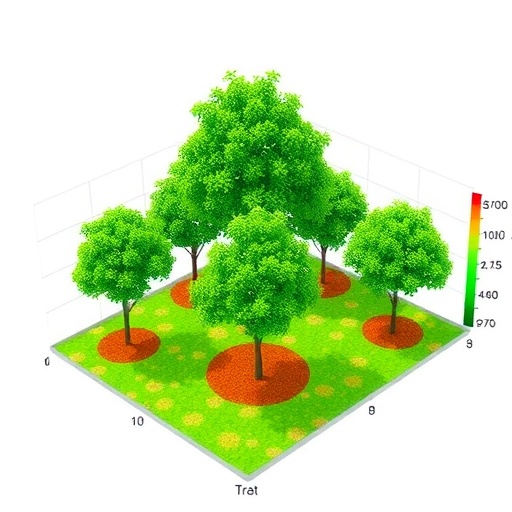
In the ever-evolving battle for sustainable urban development, a groundbreaking study by Yazdi, Chen, Rötzer, and colleagues introduces an innovative 3D target-driven optimization tool aimed at revolutionizing how cities approach tree planting. This novel approach harnesses the dynamic geometry of tree crown development over time, providing city planners and environmentalists with an unprecedented capability to maximize the ecological and social benefits of urban forestry. Published in npj Urban Sustainability in 2026, this research offers a visionary pathway towards greener, healthier cities whose environmental infrastructure is as dynamic as the urban population it supports.
Urban tree planting, traditionally constrained by static tools and simplistic spatial analyses, has long struggled with maximizing tree benefits while minimizing conflicts with infrastructure and urban space limitations. The authors have confronted this challenge through an advanced computational framework that considers the temporal evolution of tree crowns—the three-dimensional growth and spread of a tree’s canopy. This dynamic perspective is not merely academic; it directly addresses the real-world complexities such as light availability, air quality improvement, shade provision, and spatial conflicts as trees mature. By integrating such data into a 3D optimization model, the tool dynamically forecasts and adjusts tree locations to optimize overall urban canopy goals.
At the core of this innovation lies a sophisticated algorithm that synthesizes high-resolution spatial data, temporal growth models, and urban environmental constraints. The researchers leveraged extensive urban forestry datasets combined with species-specific crown morphology. This enabled the modeling of intricate canopy architectures and their growth trajectories. The tool simulates how individual trees interact with their surroundings and with each other over time, predicting their crown expansion and shadows, thus providing a comprehensive view of the future urban forest landscape decades ahead.
Significantly, this optimization tool is target-driven, meaning it can be tuned to achieve specific ecological, social, or aesthetic goals. For example, cities might prioritize maximizing shade in pedestrian-heavy areas, reducing heat islands, or enhancing biodiversity corridors. By allowing users to define these objectives as mathematical targets, the software flexibly recalibrates planting strategies to ensure that the tree distribution aligns perfectly with the desired outcomes. This capacity to tailor strategies to unique urban needs marks a substantial advance over previous, more generic approaches.
One of the most groundbreaking features of this system is its ability to simulate temporal tree crown development—tracking how individual trees grow in volume and shape through seasons and years. Traditional urban forestry models often considered trees as static entities, ignoring the changing geometry that strongly influences ecological functions such as carbon sequestration, pollutant filtration, and microclimate regulation. By incorporating detailed growth models, the proposed tool acknowledges that the benefits and challenges related to urban trees fluctuate and evolve, requiring planning that can adapt along these timelines.
The implications of these advances extend far beyond mere spatial optimization. Environmental justice issues, species selection to maximize habitat connectivity, urban heat mitigation, and vibrant community aesthetics are all fields that benefit from this research. Through time-sensitive simulations, urban foresters are empowered to predict potential conflicts with power lines, building facades, or pedestrian walkways before they arise, reducing maintenance costs and increasing tree survival rates. The system’s foresight capacity thus represents both a financial and ecological win.
Interestingly, the integration of 3D spatial analysis with temporal dynamics reflects a broader trend in environmental sciences toward embracing complexity rather than reducing it. Where past practices favored simplistic metrics—such as trees per hectare—the proposed tool offers a calculated embrace of variability: canopy shape, growth velocity, environmental interactions, and target-specific goals all coexist harmoniously within a single model. Such multidimensional modeling is state-of-the-art, signaling a paradigm shift in how urban green infrastructures are conceptualized and operationalized.
The tool’s potential to influence policy-making is equally compelling. As urban areas grapple with competing land use demands, evidence-based decisions are critical for sustainable transformations. Yazdi and colleagues provide policymakers with a digital environment to run “what-if” scenarios, testing different planting configurations against diverse urban development scenarios. This capability allows governments to balance green space expansion with infrastructural growth without unintended consequences, supporting long-term planning transparency and accountability.
Beyond environmental gains, the research contributes significantly to community engagement and public health. Trees serve as vital urban lungs, improving air quality and offering psychological relief from densely built environments. By optimizing tree placements to enhance shade and natural cooling, cities using this tool can directly address rising urban heat challenges exacerbated by climate change. Extensive shade coverage in parks, streets, and playgrounds not only encourages outdoor activity but also protects vulnerable populations from extreme temperature risks.
Technologically, the project represents a successful marriage of ecological modeling, machine learning optimization, and urban planning expertise. The authors deployed cutting-edge computer graphics techniques to render and manipulate 3D canopy geometries, while optimization routines iteratively refine tree locations for maximal efficacy. This integration showcases how interdisciplinary collaboration is essential for crafting solutions that are both scientifically robust and practically applicable in complex urban settings.
Furthermore, the tool offers modularity and scalability — vital characteristics for widespread adoption. Whether used in small neighborhood projects or large metropolitan canopy programs, the framework adapts to various scales without loss of precision. The cloud-based computational engine facilitates rapid scenario testing and visualization, democratizing access for municipal planners with varying technical capabilities. This accessibility promises to accelerate the global transition toward smarter urban forestry management.
Publications such as this one underscore the importance of marrying detailed biological understanding with sophisticated computational approaches. The temporal aspect of tree crown development, linked intricately with 3D spatial optimization, is a unique contribution that can redefine sustainable urban landscapes. As cities worldwide face increasing population density and climate destabilization, tools that optimize natural capital yield exponentially greater social and ecological returns, particularly when they enable anticipatory action rather than reactive adjustments.
Looking ahead, the authors suggest integrating real-time remote sensing data and environmental monitoring to further refine growth predictions and adaptive management practices. Coupling these enhanced feedback loops with citizen science input and IoT sensor networks could transform urban tree optimization into a living, self-correcting system. Such evolutionary urban forestry systems will be indispensable for resilient city planning in unpredictable climatic futures.
In sum, this pioneering optimization tool signals a major leap forward for urban sustainability science. By capturing the nuanced, continually evolving geometry of tree crowns and aligning it with explicit urban targets, the authors have charted a course toward greener, healthier, and more adaptive cities. As this tool scales globally, it promises to reshape urban forestry from a static plantation task into a dynamic, goal-driven ecosystem service provider, promising profound impacts in environmental quality, social equity, and urban life quality.
Subject of Research: 3D optimization of urban tree planting location using temporal tree crown growth development
Article Title: A 3D target-driven optimisation tool for tree planting location using temporal tree crown geometry development
Article References:
Yazdi, H., Chen, X., Rötzer, T. et al. A 3D target-driven optimisation tool for tree planting location using temporal tree crown geometry development. npj Urban Sustain (2026). https://doi.org/10.1038/s42949-026-00350-z
Image Credits: AI Generated


