
Saturday, February 14, 2026
Science
No Result
View All Result
  • Login
  • HOME
  • SCIENCE NEWS
  • CONTACT US
  • HOME
  • SCIENCE NEWS
  • CONTACT US
No Result
View All Result
Scienmag
No Result
View All Result
Home Science News Technology and Engineering

3D Integrated Red Micro-LED Display on Silicon

January 20, 2026
in Technology and Engineering
Reading Time: 4 mins read
0
66
SHARES
599
VIEWS
Share on FacebookShare on Twitter
ADVERTISEMENT

In recent years, the development of monolithic three-dimensional integration technology has drawn significant attention due to its potential to revolutionize display technology. At the forefront of this advancement is the quest for ultrahigh-resolution displays, which can ultimately lead to more immersive visual experiences. Traditional methods require precise mechanical alignment between driving circuits and light-emitting diode (LED) pixels, a requirement that imposes constraints on both cost and manufacturing efficiency. However, the introduction of monolithic integration could fundamentally change how these components are structured together by eliminating misalignment issues entirely.

Despite the promising outlook, challenges remain, particularly in the realm of red micro-LEDs. These components, commonly fabricated from AlGaInP/GaInP materials, have been hindered by their low quantum efficiency, which deteriorates further as the size of the pixels is reduced. For applications that demand high pixel density, such as next-generation displays, these limitations pose a significant obstacle to achieving ideal performance levels. The need for an innovative approach becomes glaring in light of these challenges.

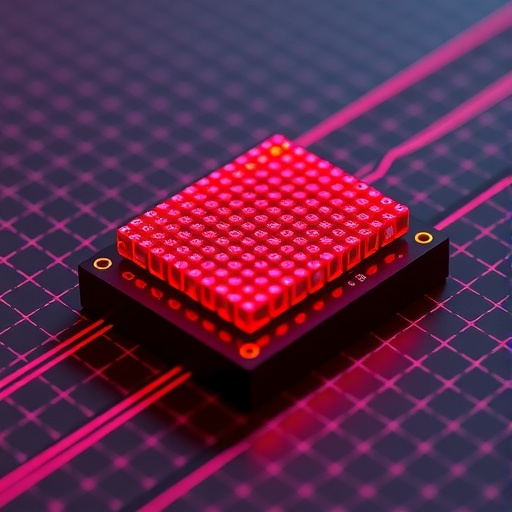
A recent study sheds light on this issue by showcasing a red active-matrix display with an astonishing pixel density of 1,700 pixels per inch. This impressive feat is made possible through the use of micro-LEDs based on a new epitaxial AlInP/GaInP double-quantum-well structure. Interestingly, these micro-LEDs are coupled with silicon complementary metal–oxide–semiconductor (CMOS) integrated circuits. The synergy between the micro-LEDs and the drive circuitry enhances the performance and versatility of the display, paving the way for unprecedented possibilities in visual technology.

Central to the performance of these micro-LEDs is their internal quantum efficiency, which is remarkably high at lower current densities, specifically below 10 A cm−2. This efficiency is attributed to a design that utilizes a hole-dominant quantum well. By effectively reducing non-radiative recombination processes, particularly the Shockley–Read–Hall recombination caused by electron lateral diffusion, the overall efficiency can be maintained even as pixel sizes shrink. This breakthrough could redefine the limits of what is achievable in micro-LED technology, opening new avenues for high-definition displays without the usual trade-offs.

Moreover, the new design cleverly incorporates thickness fluctuation scattering within the quantum well. This innovative approach assists in minimizing the size-dependent shift in quantum efficiency that typically occurs when scaling down the red micro-LEDs. The result is a more robust performance across a range of pixel dimensions, effectively allowing manufacturers to push the boundaries of pixel density while retaining effective luminosity and quality of output.

The implications of these advancements are far-reaching. Given the rapidly evolving landscape of display technologies, the ability to create high-density displays with minimized mechanical alignment challenges and enhanced quantum efficiency might allow for new product categories in consumer electronics. Imagine smartphones and televisions that display visuals with an unprecedented level of detail and richness, fundamentally altering how content is consumed and experienced.

As the research progresses, we might also witness further refinements in the materials and structures used in these micro-LEDs. With continuous improvements in fabrication techniques and materials science, the integration of these technologies could lead to more compact, energy-efficient displays. This would not only benefit consumer products but would also enhance applications in industries that demand high-performance displays, such as medical imaging and advanced visualization systems.

The progress in this field represents a critical step towards realizing more dependable and versatile display technologies. By overcoming the existing limitations relevant to smaller pixel sizes and maintaining efficiency, the researchers are contributing to a larger narrative in display technology that links to the very notions of what high-resolution truly means. Through actionable solutions derived from science and engineering, we are inching closer to realizing displays that will captivate and engage audiences in ways previously thought to be fantasies.

The momentum of this research may catalyze collaborations among various sectors, leading to partnerships that often yield groundbreaking applications. By working across disciplines that include materials science, electrical engineering, and design, we witness a confluence of expertise that can propel more innovative solutions to the market. As the demand for high-quality visual experiences continues to grow, these partnerships will be vital in fueling further advancements in micro-LED technology.

In summary, the evolution of monolithic three-dimensional integration in micro-LED technology represents a substantial leap forward in achieving high-density displays. The successful development of red micro-LEDs utilizing an epitaxial AlInP/GaInP double-quantum-well structure signifies not only an improvement in performance metrics but also a harbinger for future advancements in consumer and enterprise-level display technologies alike. It marks a new chapter in the journey toward ultrahigh-resolution displays that blend aesthetic appeal, functionality, and immersive visual experiences.

This research not only reinstates the potential of micro-LEDs in contemporary applications but also instills optimism for what lies ahead. As researchers and engineers continue to push the boundaries of performance and efficiency, we are sure to see an era where displays are no longer just tools for information dissemination but instead become integral components of our digital and interactive environments, enhancing our daily lives in unimaginable ways.

Subject of Research: Monolithic three-dimensional integration technology and its application in high-density displays.

Article Title: A monolithic three-dimensional integrated red micro-LED display on silicon using AlInP/GaInP epilayers.

Article References:

Park, J., Baek, W., Kim, H. et al. A monolithic three-dimensional integrated red micro-LED display on silicon using AlInP/GaInP epilayers.
Nat Electron (2026). https://doi.org/10.1038/s41928-025-01546-4

Image Credits: AI Generated

DOI: https://doi.org/10.1038/s41928-025-01546-4

Keywords: micro-LED technology, quantum efficiency, display technology, AlInP/GaInP, high pixel density.


Tags: 3D integrated display technologyactive-matrix display technologyadvancements in semiconductor display materialsAlGaInP/GaInP materials in displayshigh pixel density display advancementsimmersive visual experiences in displaysinnovative approaches in LED technologymonolithic integration in electronicsnext-generation display applicationspixel alignment in LED manufacturingred micro-LED efficiency challengesultrahigh-resolution micro-LEDs
Share26Tweet17
Previous Post

Psychological Needs Impact Turkish Couples’ Relationship Satisfaction

Next Post

Boosting Link Prediction in Biomedical Knowledge Graphs

Related Posts

blank
Technology and Engineering

Unveiling the Evolution of Sharp Vision: Insights from Lab-Grown Retinas

February 13, 2026
blank
Technology and Engineering

Tracking Individuals Affected by Natural Disasters

February 13, 2026
blank
Technology and Engineering

Study Reveals Generative AI Can Hallucinate Alongside Users, Not Just at Them

February 13, 2026
blank
Technology and Engineering

Revolutionizing Intracellular Antibody Design with AI-Driven Protein Engineering

February 13, 2026
blank
Technology and Engineering

Breaking Ground in Lithium Battery Cathode Materials: A New Era Begins

February 13, 2026
blank
Technology and Engineering

Revolutionizing Solar Manufacturing: A Potential Eight Billion Tonnes Reduction in Global Emissions

February 13, 2026
Next Post
blank

Boosting Link Prediction in Biomedical Knowledge Graphs

  • Mothers who receive childcare support from maternal grandparents show more parental warmth, finds NTU Singapore study

    Mothers who receive childcare support from maternal grandparents show more parental warmth, finds NTU Singapore study

    27612 shares
    Share 11041 Tweet 6901
  • University of Seville Breaks 120-Year-Old Mystery, Revises a Key Einstein Concept

    1018 shares
    Share 407 Tweet 255
  • Bee body mass, pathogens and local climate influence heat tolerance

    662 shares
    Share 265 Tweet 166
  • Researchers record first-ever images and data of a shark experiencing a boat strike

    529 shares
    Share 212 Tweet 132
  • Groundbreaking Clinical Trial Reveals Lubiprostone Enhances Kidney Function

    516 shares
    Share 206 Tweet 129
Science

Embark on a thrilling journey of discovery with Scienmag.com—your ultimate source for cutting-edge breakthroughs. Immerse yourself in a world where curiosity knows no limits and tomorrow’s possibilities become today’s reality!

RECENT NEWS

  • To give you the best rewrite, I have categorized these by the “vibe” of your magazine post. Since it is for February 2026, these titles lean into the future of oncology and proactive health.

    The “Cutting Edge” Approach (Best for Tech/Research focused feeds)

    • The Next Frontier in Oncology: Sylvester’s February 2026 Breakthrough Brief
    • Precision and Prevention: New Cancer Insights from Sylvester (Feb ‘26)
    • Future-Proofing Your Health: The Sylvester Cancer Center Research Update
    • Decoding Cancer: Advanced Strategies from Sylvester’s 2026 Tip Sheet

    The “Actionable & Health” Approach (Best for General Wellness readers)

    • Smart Moves: Your February Guide to Cancer Prevention & Care
    • Sylvester Cancer Center: Essential Health Takeaways for February 2026
    • Living Proactively: New Cancer Prevention Standards for the Year Ahead
    • The Cancer Fighter’s Toolkit: Sylvester’s Latest Expert Recommendations

    The “Punchy & Modern” Approach (Best for Social Media/Newsletters)

    • Sylvester’s Top Cancer Tips for Feb 2026
    • The February Edit: Innovations in Cancer Care
    • Cancer Care 2026: What You Need to Know This Month
    • Sylvester Intelligence: New Guidelines for Cancer Prevention

    The “Science Journalism” Approach (Best for a formal magazine header)

    • Monthly Briefing: Breakthroughs in Clinical Oncology from Sylvester
    • Current Trends in Cancer Research: The Sylvester February Report
    • Reporting from Sylvester: New Paradigms in Early Detection and Treatment

    Which one should you choose?

    • If your magazine is high-tech: Use “The Next Frontier in Oncology.”
    • If your magazine is lifestyle-oriented: Use “Your February Guide to Cancer Prevention.”
    • If your magazine is a quick news digest: Use “Sylvester’s Top Cancer Tips for Feb 2026.”
  • Here are several ways to rewrite that headline, depending on the “vibe” of your magazine:

    The “Cutting Edge” Approach

    • Bridging the Gap: How Telehealth is Revolutionizing Genetic Care for Childhood Cancer Survivors
    • The Virtual Clinic: Virtual Consults Break Down Barriers to Genetic Testing for Adult Survivors

    The Human-Interest Approach

    • Lifesaving Connections: Telehealth Brings Expert Genetic Counseling to Childhood Cancer Survivors Everywhere
    • No Specialist Nearby? No Problem. How Remote Care is Protecting the Future of Cancer Survivors

    Short & Punchy (Best for Social Media/Web)

    • Virtual Genetics: A New Lifeline for Childhood Cancer Survivors
    • Webcam Consults are Narrowing the Care Gap for Adult Survivors
    • Telehealth: The New Frontier in Post-Cancer Genetic Screening

    Academic/Serious

    • Overcoming Geographical Barriers: The Rise of Telegenetics in Long-Term Survivorship Care
    • Closing the Access Gap: Telemedicine’s Vital Role in Genetic Services for Adult Survivors

    Which one should you choose?

    • If your magazine is scholarly, go with the “Academic” options.
    • If your magazine is consumer-facing/lifestyle, go with the “Human-Interest” options.
    • If you need to drive clicks, go with the “Short & Punchy” options.
  • Here are a few ways to rewrite that headline for a science magazine, depending on the tone and focus you want to take:

    Focus on Urgency & Accuracy

    • Outdated Famine Metrics are Failing the Hungry: Why Modern Data is Critical to Saving Lives
    • The Deadly Lag: How Obsolete Mortality Benchmarks Mask the Onset of Mass Starvation
    • Why Using Old Death Rate Models Means We’re Identifying Famines Too Late

    Focus on the Scientific/Analytical Aspect

    • The Science of Starvation: Rethinking How We Measure Famine in a Changing World
    • Beyond the Threshold: Why Current Mortality Benchmarks Underestimate Modern Crises
    • Calibration Crisis: The Need for Real-Time Metrics in Humanitarian Science

    Short & Punchy (Social Media Friendly)

    • When Metrics Fail: The Hidden Reality of Modern Famine
    • Is Our Definition of Famine Costing Lives?
    • Famine Detection is Broken. Here’s How to Fix It.

    Narrative / Provocative

    • Waiting for the Bodies: The Dangerous Flaw in How We Declare Famine
    • The Math of Survival: Why Famine Recognition Lags Behind Reality

    Main Recommendation:

    “The Deadly Delay: Why Outdated Mortality Benchmarks Miss the Early Signs of Famine”

    Why this works for a science magazine: It highlights a specific technical flaw (benchmarks) while emphasizing the real-world consequence (delay/mortality).

  • Here are several ways to rewrite the headline, depending on the “voice” of your magazine:

    The “Skeptical & Sharp” Approach (Focus on the Gap)

    • The Age of the Archetype: Why Seniors Are Misinformation’s Biggest Target
    • Not All Scrolls Are Equal: Older Adults Bear the Brunt of Medical Myths
    • The Digital Divide of Deception: Why Medical Misinformation Hits Seniors Hardest

    The “Action & Solution” Focused Approach

    • Stemming the Tide: Addressing the Surge of Medical Myths Among Older Generations
    • Media Literacy for All: Why We Need to Close the Senior Misinformation Gap
    • Vaccinating against Lies: How Medical Misinformation Is Concentrating Among Older Adults

    The “Curiosity & Study-Driven” Approach (Best for research deep-dives)

    • Who Swallows the Bait? Study Finds Seniors at Ground Zero for Medical Fake News
    • Beyond the Click: The Social Dynamics Behind Seniors and Health Misinformation
    • Data Deep Dive: Why Older Adults Are Disproportionately Exposed to Medical Myths

    Short & Punchy (Social Media Friendly)

    • Seniors: The Unintended Audience for Online Medical Myths
    • The Growing Threat of Health Misinformation in Older Age Groups
    • Why Medical Myths Travel Faster Among Older Adults

    My Top Recommendation:

    “The Gray Area of Truth: Why Online Medical Misinformation Is Concentrating Among Older Adults” (It uses a clever play on words while remaining professional and descriptive of the study findings.)

Categories

  • Agriculture
  • Anthropology
  • Archaeology
  • Athmospheric
  • Biology
  • Biotechnology
  • Blog
  • Bussines
  • Cancer
  • Chemistry
  • Climate
  • Earth Science
  • Editorial Policy
  • Marine
  • Mathematics
  • Medicine
  • Pediatry
  • Policy
  • Psychology & Psychiatry
  • Science Education
  • Social Science
  • Space
  • Technology and Engineering

Subscribe to Blog via Email

Success! An email was just sent to confirm your subscription. Please find the email now and click 'Confirm Follow' to start subscribing.

Join 5,190 other subscribers

© 2025 Scienmag - Science Magazine

Welcome Back!

Login to your account below

Forgotten Password?

Retrieve your password

Please enter your username or email address to reset your password.

Log In
No Result
View All Result
  • HOME
  • SCIENCE NEWS
  • CONTACT US

© 2025 Scienmag - Science Magazine