

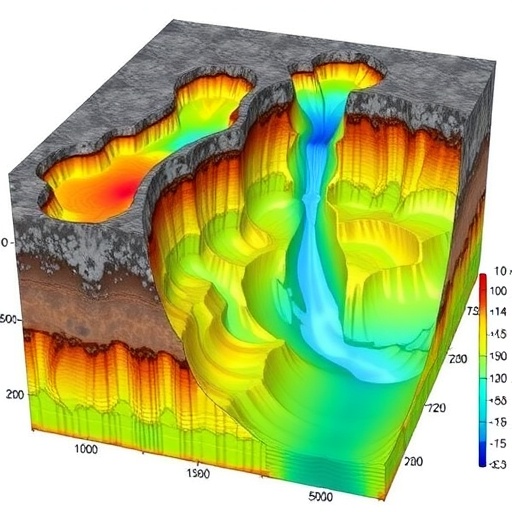
In an unprecedented breakthrough, researchers have unveiled a cutting-edge simulation technique elucidating the anisotropic seepage behavior within three-dimensional heterogeneous coal fractured by liquid nitrogen. This innovative study, published in Environmental Earth Sciences, sheds critical light on how liquid nitrogen treatment alters the internal structure of coal seams, driving new possibilities for enhanced methane recovery and coal seam stabilization. The research addresses the complex interactions between cryogenic fluids and geologic materials, a domain that has been notoriously challenging to model and understand with precision until now.
Central to this investigation is the concept of anisotropic seepage—an irregular, direction-dependent flow pattern that results from the intricate heterogeneous nature of fractured coal. Traditional simulation models have struggled to capture this behavior, often assuming isotropic properties that oversimplify and underestimate the flow dynamics. This new model, however, incorporates spatial variations in coal permeability and fracture orientation, successfully reproducing real-world seepage observations. By leveraging advanced numerical methods combined with three-dimensional spatial data, the study breaks new ground in accurately representing the physics of fluid migration under cryogenic influences.
The impetus for this research stems from the quest to optimize liquid nitrogen fracturing, a technique increasingly utilized to enhance coalbed methane extraction efficiency. When liquid nitrogen is injected into coal seams, it not only cools the rock but induces micro-cracks that propagate anisotropically due to natural fractures and heterogeneities. This process substantially modifies the permeability landscape of the coal mass, facilitating enhanced gas drainage. Until now, however, the precise impact of this fracturing pattern on fluid migration was poorly understood. This simulation provides a comprehensive map of how seepage evolves under such conditions, offering insights that could transform field-scale operations.
What makes this study stand out is its meticulous attention to the 3D heterogeneity of coal. Coal formations rarely exhibit uniform properties; instead, they feature complex assemblages of cleats, fractures, and macerals with varying permeability and porosity. The simulation framework developed by Gan, Qiao, Fan, and their colleagues integrates detailed geological characterizations with cryogenic fluid dynamics to represent this complexity faithfully. This approach not only captures directional seepage but also accounts for temporal evolution as liquid nitrogen interacts with the rock matrix, cooling and fracturing it sequentially.
The researchers deployed a multi-physics simulation platform that couples thermal, hydraulic, and mechanical processes, recognizing the intimate coupling among fluid flow, temperature gradients, and rock deformation. Liquid nitrogen’s extreme cold triggers thermal contraction in the coal, promoting fracture propagation and altering fluid pathways. By simulating these effects simultaneously, the model realistically captures the ongoing evolution of coal permeability and the corresponding changes in seepage behaviors. This holistic approach marks a significant step forward in predictive modeling of subsurface cryogenic processes.
Results from this study reveal that seepage velocities are highly dependent on fracture orientation relative to the principal stress directions. Permeability anisotropy manifests distinctly in zones where induced fractures align with pre-existing cleats, creating preferential flow channels. Conversely, regions with orthogonal fracture intersections exhibit slower fluid movement due to more tortuous pathways. These nuanced findings enable a granular understanding of how anisotropic permeability fields govern fluid migration and could be leveraged to design more effective injection strategies.
Beyond methane recovery, the implications of this research extend to environmental engineering and carbon sequestration efforts. Accurate simulations of anisotropic seepage in coal can inform assessments of contaminant migration risks and the stability of geologic carbon storage sites subjected to cryogenic conditions. Furthermore, this knowledge aids in predicting the longevity and integrity of coal seams exposed to liquid nitrogen treatment, enhancing the safety and sustainability of resource extraction.
The study’s technical rigor is underscored by its use of a validated numerical solver integrated with real-world geological data obtained from field surveys and core samples. By calibrating the simulation against experimental benchmarks, the authors ensured high fidelity in their predictions. This methodological transparency adds confidence in applying the model to diverse geological contexts and scaling up from laboratory conditions to operational mines.
One of the striking aspects of the research is its detailed portrayal of seepage anisotropy over time. Initially, liquid nitrogen injection forms rapid, directional fractures that promptly accelerate seepage along these new conduits. However, as thermal equilibrium approaches, the formation of secondary fractures and rock matrix swelling modulate flow patterns, sometimes leading to temporary decreases in seepage rates. This dynamic interplay captured in the simulation highlights the transient nature of fracture network evolution under cryogenic influences.
Moreover, the study incorporates advanced visualization techniques to render the complex three-dimensional flow fields within fractured coal. These visualizations enable intuitive interpretation of otherwise abstract anisotropic seepage trends, providing stakeholders with readily accessible insights into subsurface fluid behavior. This communicative aspect is critical for bridging the gap between theoretical modeling and practical engineering applications.
The impact of this investigation is likely to resonate across disciplines, stimulating renewed interest in the interactions between cryogenic fluids and geologic materials. Its methodological innovations offer a blueprint for future studies examining other heterogeneous rocks subjected to extreme thermal conditions, such as permafrost soils or deep shale formations. By demonstrating that highly detailed, coupled simulations can accurately reflect physical processes at the microscale and macroscale, the research challenges the status quo in subsurface flow modeling.
Looking ahead, the authors suggest expanding their framework to incorporate chemical effects, such as cryogenic-induced mineral transformations, which could further affect permeability and seepage behavior. Integrating such geochemical reactions would yield even richer predictive capability, empowering engineers to anticipate long-term changes in reservoir properties post-injection. This forward-looking vision highlights the evolving frontier at the intersection of thermal hydraulics, rock mechanics, and geochemistry.
In conclusion, the simulation of anisotropic seepage in 3D heterogeneous coal fractured by liquid nitrogen represents a transformative advance in understanding and harnessing the complexities of subsurface fluid dynamics under extreme conditions. By accurately portraying how directional seepage pathways develop and evolve in a realistically heterogeneous medium, the study sets a new standard for scientific inquiry and practical exploitation of coal seams. This pioneering work not only promises more efficient methane recovery but also safer and more environmentally responsible resource management.
The study by Gan, Qiao, Fan, and colleagues challenges conventional paradigms by emphasizing the uniqueness of anisotropic behavior in fractured coal systems. Their advanced computational model bridges intricate subsurface physics with actionable engineering insights, marking an essential leap forward in resource and environmental geoscience. As cryogenic technologies continue to reshape energy extraction and environmental remediation, innovations such as this will be indispensable for guiding future practices with precision and confidence.
Subject of Research:
Simulation of anisotropic seepage in three-dimensional heterogeneous coal fractured by liquid nitrogen injection.
Article Title:
Simulation of Anisotropic Seepage in 3D Heterogeneous Coal Fractured by Liquid Nitrogen
Article References:
Gan, M., Qiao, Y., Fan, N. et al. Simulation of anisotropic seepage in 3D heterogeneous coal fractured by liquid nitrogen. Environ Earth Sci 85, 74 (2026). https://doi.org/10.1007/s12665-025-12759-3
Image Credits:
AI Generated


