

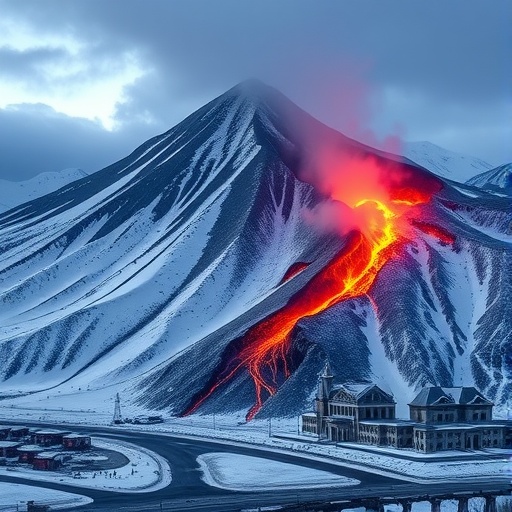
In a groundbreaking study published in “Commun Earth Environ,” a team of scientists led by Liu Yang, alongside collaborators Cheng Gao and Feng Liu, investigates the lingering impact of the 1783 Laki eruption on global climate patterns, specifically regarding winter warming trends over Northern Eurasia. This research delves into a significant meteorological phenomenon often overlooked—how stratospheric aerosols from historical volcanic eruptions can create extended warming periods in regions that are usually synonymous with cold, harsh winters.
The Laki eruption in Iceland unleashed an astonishing volume of sulfur dioxide into the atmosphere, resulting in a series of atmospheric changes that led to the formation of stratospheric aerosols. These tiny droplets, suspended high above the Earth’s surface, play a crucial role in altering radiative forcing, which is the balance of solar energy absorbed by the Earth and the energy radiated back into space. The study demonstrates that these aerosols, while often associated with short-term cooling effects, can also contribute to unexpected warming, especially in winter months.
Research conducted by Yang and his team reveals the complex mechanisms behind this phenomenon. The aerosols emitted by the Laki eruption underwent a form of atmospheric evolution that allowed them to persist for years, impacting the radiative properties of the atmosphere well beyond their initial dispersal. By analyzing climate models alongside historical temperature data, the researchers illustrate how this volcanic activity altered both temperature and precipitation patterns in Northern Eurasia during the winter months, creating a significant warming effect that deviated from typical climatic expectations.
Further studies indicate that the phenomenon caused by the Laki eruption serves as a prime example of how natural events can lead to significant climatic shifts, showcasing the intricate dynamics of the Earth’s climate system. The findings hold crucial implications for understanding contemporary climate changes, with aerosol emissions from other sources, including industrial activity, potentially influencing current climatic conditions in ways that are not fully understood. This research underlines the importance of comprehensive climate modeling that incorporates historical volcanic activity and its lingering effects on global climate.
Interestingly, the study also draws upon evidence from ice cores and sediment records to provide a longitudinal perspective on the climatic consequences of the Laki eruption. Using these records, the researchers present a compelling case for the role of persistent aerosols in altering atmospheric circuits and blocking solar radiation, leading to the unusual warming trends observed in Northern Eurasia during the 18th century and beyond. The cross-disciplinary approach, combining climatology, geology, and advanced modeling techniques, sets a precedent for future studies investigating the long-term impacts of past climatic events.
Moreover, the team emphasizes the need for policymakers and climate scientists to recognize the potential ramifications of prolonged aerosol persistence in today’s context of anthropogenic climate change. While modern volcanic activity may contribute to climate effects on a short-term basis, the lingering implications observed with the Laki eruption can serve as an essential case study for understanding how future volcanic eruptions could exacerbate existing climate challenges.
The research also poses intriguing questions regarding the interaction between natural and human-made climate factors. As emissions from industrial activities parallel the effects of historical volcanic eruptions, understanding these interactions becomes vital for anticipating future climatic shifts. The Laki eruption serves as a stark reminder that while natural climatic events can provide temporary relief or stress in winters, they can also introduce long-term variabilities that affect ecosystems, agriculture, and weather patterns.
Furthermore, the interdisciplinary nature of this research fosters collaboration among climate scientists and historians alike, moving beyond the boundaries of traditional climate studies. By assessing how historical climatic shifts dictated human activity, such as crop yields and societal structures, the study highlights the interconnectedness of humanity and the environment through time.
Yang’s research addresses a gap in existing literature regarding the specific consequences of historical volcanic eruptions on modern climate models. By demonstrating how the aerosols from the Laki eruption could still be influencing climate variability nearly three centuries later, the implications of their study extend beyond mere academic interest. They touch upon crucial global discussions surrounding climate resilience, adaptation, and mitigation strategies.
In summary, the work produced by Yang and colleagues represents a pivotal advance in the understanding of how past volcanic activity influences current climate dynamics. This deep dive into the persistent effects of the Laki eruption is not just a historical analysis; it serves as a clarion call for further research into the long-term effects of aerosols. Climate scientists are urged to consider the evolutionary nature of aerosols when forecasting future climate scenarios, especially regarding the unpredictability of winter weather patterns in Northern Eurasia and beyond.
As policymakers around the globe grapple with the ramifications of a rapidly changing climate, the insights derived from this comprehensive analysis will undoubtedly be critical in forming strategies aimed at resilience and adaptation to extreme weather phenomena. With continual advancements in climate modeling and a deeper understanding of historical volcanic impacts, the road ahead may not be as bleak as it once appeared, provided that lessons from the past inspire actionable change in the present.
The study ultimately highlights the delicate balance of Earth’s climatic systems and the importance of learning from the past to prepare for the future. As science delves deeper into the understanding of how these systems interact, the knowledge gleaned can help guide informed decisions that affect generations to come.
In conclusion, this remarkable investigation into the climatic repercussions of the Laki eruption and the subsequent warming trends in Northern Eurasia not only enriches our understanding of climate science but also reminds us of the potent forces at play within our planet’s atmosphere. By linking the past with present climate realities, researchers pave the way for a more nuanced understanding of our environment, its rapid changes, and the implications for ecosystems and human societies worldwide.
Subject of Research: The impact of the 1783 Laki eruption on climate, focusing on stratospheric aerosols and winter warming over Northern Eurasia.
Article Title: Persistent stratospheric cold-season aerosols from the 1783 Laki eruption produced winter warming over Northern Eurasia.
Article References:
Yang, L., Gao, C., Liu, F. et al. Persistent stratospheric cold-season aerosols from the 1783 Laki eruption produced winter warming over Northern Eurasia. Commun Earth Environ (2026). https://doi.org/10.1038/s43247-026-03197-5
Image Credits: AI Generated
DOI: 10.1038/s43247-026-03197-5
Keywords: Laki eruption, stratospheric aerosols, winter warming, Northern Eurasia, climate change, historical climate effects, volcanic activity, radiative forcing.


