

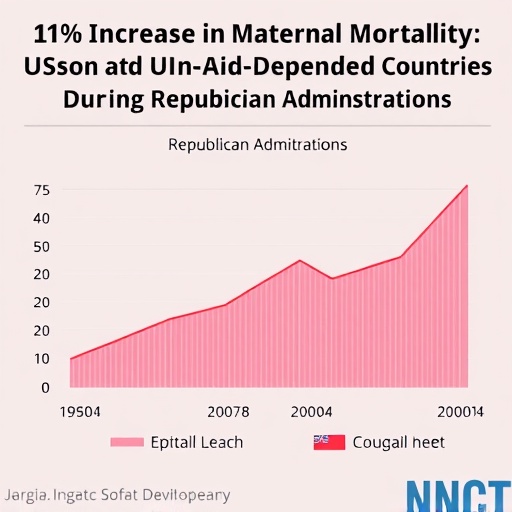
A newly published data-driven study in BMJ Global Health reveals a striking correlation between shifts in US presidential administrations and global maternal mortality rates. The research highlights an approximately 11% increase in maternal deaths in countries heavily dependent on US foreign aid following transitions from Democratic to Republican presidencies. This surge translates to roughly 45 additional maternal deaths per 100,000 live births, effectively wiping out one-fifth of the considerable progress made globally in reducing maternal mortality since the mid-1980s.
Central to this phenomenon is the Mexico City Policy, colloquially known as the Global Gag Rule (GGR), which has wielded a profound influence on US foreign aid directed towards family planning and reproductive health services. Instituted under the Reagan administration in 1984, the policy prohibits American financial support to foreign non-governmental organizations (NGOs) engaged in abortion-related services, even if those services are partially funded by non-US sources. This policy has oscillated in enforcement aligned with the political party in power, being activated by Republican administrations and revoked under Democrats.
The Trump administration notably rebranded and broadened the policy’s scope as the Protecting Life in Global Health Assistance program, encompassing nearly all categories of US global health aid. This expansion intensified the impact on aid-receiving countries, especially those reliant on US funding for reproductive health initiatives. Researchers gathered longitudinal data spanning from 1985 through 2023 from the World Bank’s World Development Indicators to analyze maternal mortality trends and the indirect effects of the GGR, such as contraceptive use and skilled birth attendance rates.
Maternal mortality ratio, a key metric in this study, quantifies deaths among women aged 15 to 49 due to pregnancy-related complications either during pregnancy or within 42 days post-termination, per 100,000 live births. This indicator has fluctuated widely in response to US policy-induced funding shifts, underscoring the tangible health consequences of geopolitical maneuvering. The analysis encompassed 150 countries, capturing a comprehensive global picture.
When the GGR is active—which aligns with Republican presidencies in three distinct periods: 1985–1992, 2001–2008, and 2017–2020—the data demonstrate a pronounced decline in family planning aid, averaging a 48% increase under Democratic administrations compared to their Republican counterparts. Notably, aid plummets by approximately 34% per capita in nations most dependent on US assistance under Republican rule, posing significant challenges for reproductive health service delivery.
Despite overall maternal mortality reductions worldwide over the past four decades, disparities between countries heavily reliant on US aid and those less dependent remain stark. The highest differential in maternal mortality ratios can reach up to 445 excess deaths per 100,000 live births, although this chasm notably contracts whenever the GGR is inactive. This cyclical pattern reflects the oscillating political landscape in Washington and its downstream repercussions.
The GGR’s disproportionate impacts are observed across continents but vary in magnitude. Africa, while suffering the greatest absolute increase in maternal deaths, experiences a relatively lower percentage rise (7%) compared to Latin America and Asia, where the percentage increases clock in at 16% and 15% respectively. These figures emphasize the global reach of the policy’s detrimental effects and shatter the notion of localized fallout.
Quantitatively, for every US dollar increase per capita in aid dependence during GGR enforcement, an estimated 25 additional maternal deaths per 100,000 live births can be expected. This relationship underscores the policy’s capacity not only to halt progress but to actively reverse gains made in reducing maternal mortality over decades.
Beyond mortality, the GGR is implicated in subtle yet critical declines in essential reproductive health indicators. Skilled birth attendance decreases by roughly 1%, and contraceptive prevalence falls by around 2% during enforcement periods. These reductions deepen risks to maternal health by diminishing access to necessary interventions that prevent complications and promote safer childbirth outcomes.
Researchers caution that their conclusions are inherently bounded by limitations in global health data reporting, particularly in low- and middle-income countries where underreporting and misclassification of maternal deaths remain significant challenges. Nevertheless, the consistency of correlations across multiple decades and countries bolsters the reliability of these findings.
The broader repercussions of the GGR extend beyond immediate mortality statistics, encompassing various reproductive health hazards such as hemorrhage, sepsis, uterine trauma, chronic pain, and increased infertility rates. These morbidities compound the burden on healthcare systems and affected families, signaling a public health crisis fueled in part by fluctuating US policy frameworks.
During President Trump’s second term, the study highlights an alarming contraction of foreign aid for family planning, with over 90% of USAID contracts for reproductive health programs being terminated. This decimation of funding pipelines exacerbated healthcare vulnerabilities in recipient countries, compounding the adverse consequences initiated by policy reinstatements.
While the study focuses on US policy, it acknowledges a global trend towards reduced overseas development aid, suggesting an international dimension to the vulnerabilities exposed. The findings underscore the critical need for stable, depoliticized global health funding mechanisms that safeguard reproductive health gains and ensure resilience against abrupt donor policy shifts.
In summary, this comprehensive data analysis elucidates a direct link between US presidential party affiliation, corresponding foreign aid policies, and maternal health outcomes worldwide. The oscillating enforcement of the Mexico City Policy operates as a powerful determinant of maternal mortality trajectories in aid-dependent nations, illustrating the far-reaching implications of domestic political decisions on global health equity and survival.
Subject of Research: People
Article Title: US Presidential Party switches are mirrored in global maternal mortality
News Publication Date: 24-Mar-2026
Web References:
DOI: 10.1136/bmjgh-2025-020223
Keywords: Mothers, Birth control, Abortion, Obstetrics, Nongovernmental organizations, Philanthropy, Government


