

Monday, November 16, 2026
Science
No Result
View All Result
  • Login
  • HOME
  • SCIENCE NEWS
  • CONTACT US
  • HOME
  • SCIENCE NEWS
  • CONTACT US
No Result
View All Result
Scienmag
No Result
View All Result
Home Science News Biology

Enzyme PLA2G4A fuels lung cancer growth through an HSF1 signaling axis

October 29, 2026
in Biology, Medicine
Nathaniel Bowman
By Nathaniel Bowman Scienmag Editorial Profile - Precision Oncology
Reading Time: 3 mins read
0
Enzyme PLA2G4A fuels lung cancer growth through an HSF1 signaling axis

Enzyme PLA2G4A fuels lung cancer growth through an HSF1 signaling axis

65
SHARES
587
VIEWS
Share on FacebookShare on Twitter
ADVERTISEMENT

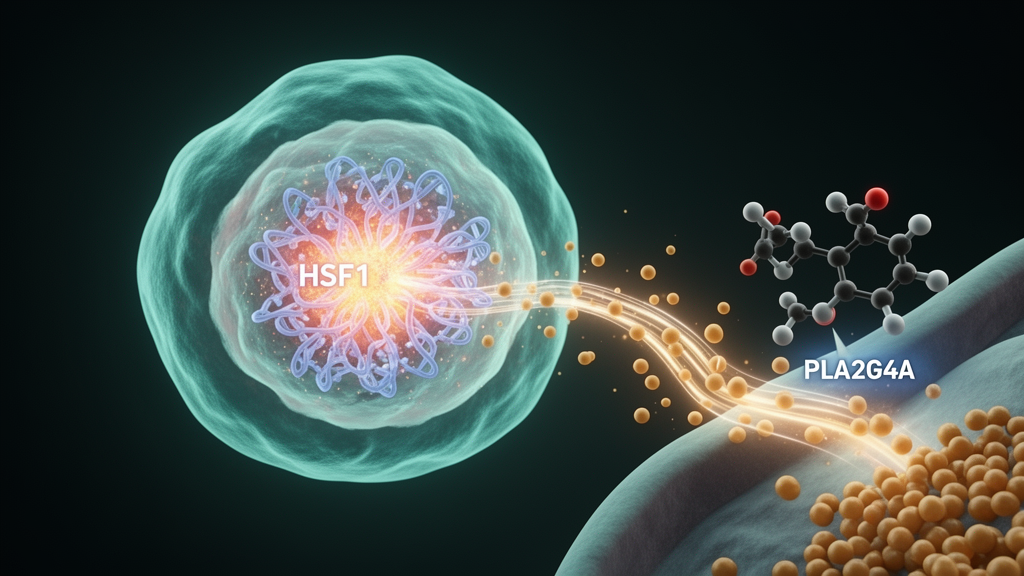
Cytosolic phospholipase A2, encoded by the gene PLA2G4A, is the rate-limiting enzyme that initiates arachidonic acid metabolism, a pathway whose aberrant activity has long been recognized as a hallmark of cancer. A new open-access study published in Cell Death Discovery reports that this enzyme acts cell-intrinsically in non-small cell lung cancer (NSCLC), promoting proliferation, survival and metastatic behavior through a signaling chain running from SP1 to PLA2G4A, then to interleukin-1β, the MAPK pathway and finally heat shock factor 1 (HSF1).

The researchers first found that PLA2G4A is significantly upregulated in NSCLC patients and in NSCLC cell lines. To test whether the enzyme actively drives malignant behavior rather than merely marking it, they performed gain-of-function experiments in 16HBE cells, a normal human bronchial epithelial cell line. Ectopic expression of PLA2G4A in these non-cancerous cells promoted proliferation and induced epithelial-mesenchymal transition, the process by which epithelial cells acquire migratory, invasive traits. When PLA2G4A was combined with MYC, a well-known oncogenic transcription factor, the pair cooperated to drive tumor formation in vivo.

The complementary loss-of-function experiments used CRISPR-Cas9 to knock out PLA2G4A in NSCLC cells. This suppressed cell proliferation, colony formation in soft agar—a standard assay for anchorage-independent growth—and invasion. At the cell-cycle level, the knockout induced arrest in the G1 phase, and the cells also underwent increased apoptosis. In animal models, PLA2G4A knockout inhibited tumor growth and reduced lung colonization, indicating effects on both primary tumor expansion and metastatic seeding.

To trace the mechanism, the team combined transcriptomic profiling with biochemical analyses. PLA2G4A knockout reduced expression of the inflammatory cytokine IL-1β and dampened MAPK pathway activity, which in turn led to decreased phosphorylation of HSF1, the heat shock factor 1 transcription factor. Pharmacological inhibition of IL-1β reproduced, or phenocopied, these cellular effects, supporting IL-1β as a functional intermediate in the pathway. Critically, when the researchers re-introduced HSF1 ectopically into PLA2G4A-deficient cells, the proliferative defect caused by PLA2G4A ablation was rescued—placing HSF1 downstream in the axis.

Upstream of the enzyme, the study identifies SP1, a transcription factor, as a candidate regulator of PLA2G4A expression. Taken together, the data suggest a largely linear signaling axis—SP1, PLA2G4A, IL-1β, MAPK, HSF1—that operates within the cancer cell itself to support NSCLC proliferation, survival and metastasis, rather than acting through the tumor microenvironment.

The authors propose that targeting this pathway may represent a potential therapeutic avenue for NSCLC. Because the work relies on cell-line experiments, engineered knockout and in vivo tumor models, the findings are preclinical; clinical efficacy in patients has not been demonstrated. The article was published as an accepted, peer-reviewed manuscript shared early under a permanent DOI, a version subject to further editorial updates before the final Version of Record.

Subject of Research: The role of PLA2G4A-driven arachidonic acid metabolism and the HSF1 signaling axis in non-small cell lung cancer progression.

Article Title: PLA2G4A-driven arachidonic acid metabolic reprogramming promotes NSCLC progression via the HSF1 signaling axis

Article References: Wang, W., Wang, Z., Li, K., Tong, X., Wen, Z., Jia, Y., Yan, J., Wang, S., Wang, H., Jin, H., Ma, T., Zhao, W., Wang, R., Li, S., Chen, T., Li, X., & Li, B. (2026). PLA2G4A-driven arachidonic acid metabolic reprogramming promotes NSCLC progression via the HSF1 signaling axis. Cell Death Discovery. https://doi.org/10.1038/s41420-026-03415-1

Image Credits: AI Generated

DOI: 10.1038/s41420-026-03415-1

Keywords: PLA2G4A, arachidonic acid, NSCLC, HSF1, IL-1β, MAPK, SP1, CRISPR-Cas9, epithelial-mesenchymal transition, lung cancer, Cell Death Discovery, phospholipase A2

Cite Scienmag News

Nathaniel Bowman. (October 29, 2026). Enzyme PLA2G4A fuels lung cancer growth through an HSF1 signaling axis. Scienmag. https://scienmag.com/enzyme-pla2g4a-fuels-lung-cancer-growth-through-an-hsf1-signaling-axis/

Nathaniel Bowman. "Enzyme PLA2G4A fuels lung cancer growth through an HSF1 signaling axis." Scienmag, 29 October 2026, https://scienmag.com/enzyme-pla2g4a-fuels-lung-cancer-growth-through-an-hsf1-signaling-axis/. Accessed 16 November 2026.

Nathaniel Bowman. "Enzyme PLA2G4A fuels lung cancer growth through an HSF1 signaling axis." Scienmag. October 29, 2026. https://scienmag.com/enzyme-pla2g4a-fuels-lung-cancer-growth-through-an-hsf1-signaling-axis/

Tags: arachidonic acidarachidonic acid metabolism in tumor growthCell Death Discoverycell-intrinsic factors in lung tumor proliferationCRISPR-Cas9CRISPR/Cas9 gene-editing in cancer researchepithelial-mesenchymal transitionepithelial-mesenchymal transition in NSCLCHSF1IL-1βlung cancerlung cancer progressionMAPKnon-small cell lung cancer molecular mechanismsNSCLConcogenic cooperation between PLA2G4A and MYCphospholipase A2PLA2G4APLA2G4A enzyme in cancerrole of IL-1β and MAPK in lung cancersignalingSP1SP1 to HSF1 signaling pathway in cancer
Share26Tweet16
Previous Post

Zebrafish drug screen finds no rescue for Marfan syndrome heart stress

Next Post

Frozen shoulder affects nearly half of diabetic patients in Pakistan, review finds

Related Posts

Integrated Strategy Linked to Higher Oocyte Yield in Diminished Ovarian Reserve
Medicine

Integrated Strategy Linked to Higher Oocyte Yield in Diminished Ovarian Reserve

November 16, 2026
Hepatic Usp2 Promotes Lipid Accumulation Through G3bp2 Protein Stabilization
Biology

Hepatic Usp2 Promotes Lipid Accumulation Through G3bp2 Protein Stabilization

November 16, 2026
Thymol and Carvacrol Reduce Diarrhea in Goat Kids by Supporting Gut Barriers
Biology

Thymol and Carvacrol Reduce Diarrhea in Goat Kids by Supporting Gut Barriers

November 16, 2026
Preclinical Advancements in Transcranial Stimulation Techniques for Neuropsychiatric Disorder Treatment
Psychology & Psychiatry

Preclinical Advancements in Transcranial Stimulation Techniques for Neuropsychiatric Disorder Treatment

November 16, 2026
Interprofessional Virtual Reality Training PAVIN Demonstrates Feasibility in Paediatric Emergency Pilot
Science Education

Interprofessional Virtual Reality Training PAVIN Demonstrates Feasibility in Paediatric Emergency Pilot

November 16, 2026
Medical Training Stage Linked to Preferred Social Media Platforms and Academic Use
Science Education

Medical Training Stage Linked to Preferred Social Media Platforms and Academic Use

November 16, 2026
Next Post
Frozen shoulder affects nearly half of diabetic patients in Pakistan, review finds

Frozen shoulder affects nearly half of diabetic patients in Pakistan, review finds

  • Mothers who receive childcare support from maternal grandparents show more optimized

    Mothers who receive childcare support from maternal grandparents show more parental warmth, finds NTU Singapore study

    27656 shares
    Share 11059 Tweet 6912
  • University of Seville Breaks 120-Year-Old Mystery, Revises a Key Einstein Concept

    1061 shares
    Share 424 Tweet 265
  • Bee body mass, pathogens and local climate influence heat tolerance

    682 shares
    Share 273 Tweet 171
  • Researchers record first-ever images and data of a shark experiencing a boat strike

    546 shares
    Share 218 Tweet 137
  • Groundbreaking Clinical Trial Reveals Lubiprostone Enhances Kidney Function

    531 shares
    Share 212 Tweet 133
Science

Embark on a thrilling journey of discovery with Scienmag.com—your ultimate source for cutting-edge breakthroughs. Immerse yourself in a world where curiosity knows no limits and tomorrow’s possibilities become today’s reality!

RECENT NEWS

  • Integrated Strategy Linked to Higher Oocyte Yield in Diminished Ovarian Reserve
  • Royal Jelly Pickering Emulsion Meets Dysphagia Requirements for 3D Printing
  • New Vision Transformer Enhances Accuracy in Chinese Ancient Architecture Image Classification
  • Hepatic Usp2 Promotes Lipid Accumulation Through G3bp2 Protein Stabilization

Categories

  • Agriculture
  • Anthropology
  • Archaeology
  • Athmospheric
  • Biology
  • Biotechnology
  • Blog
  • Bussines
  • Cancer
  • Chemistry
  • Climate
  • Earth Science
  • Editorial Policy
  • Marine
  • Mathematics
  • Medicine
  • Pediatry
  • Policy
  • Psychology & Psychiatry
  • Science Education
  • Science News
  • Social Science
  • Space
  • Technology and Engineering

Subscribe to Blog via Email

Enter your email address to subscribe to this blog and receive notifications of new posts by email.

Join 5,150 other subscribers

© 2026 Scienmag - Science Magazine

Welcome Back!

Login to your account below

Forgotten Password?

Retrieve your password

Please enter your username or email address to reset your password.

Log In
No Result
View All Result
  • HOME
  • SCIENCE NEWS
  • CONTACT US

© 2026 Scienmag - Science Magazine

Discover more from Science

Subscribe now to keep reading and get access to the full archive.

Continue reading

